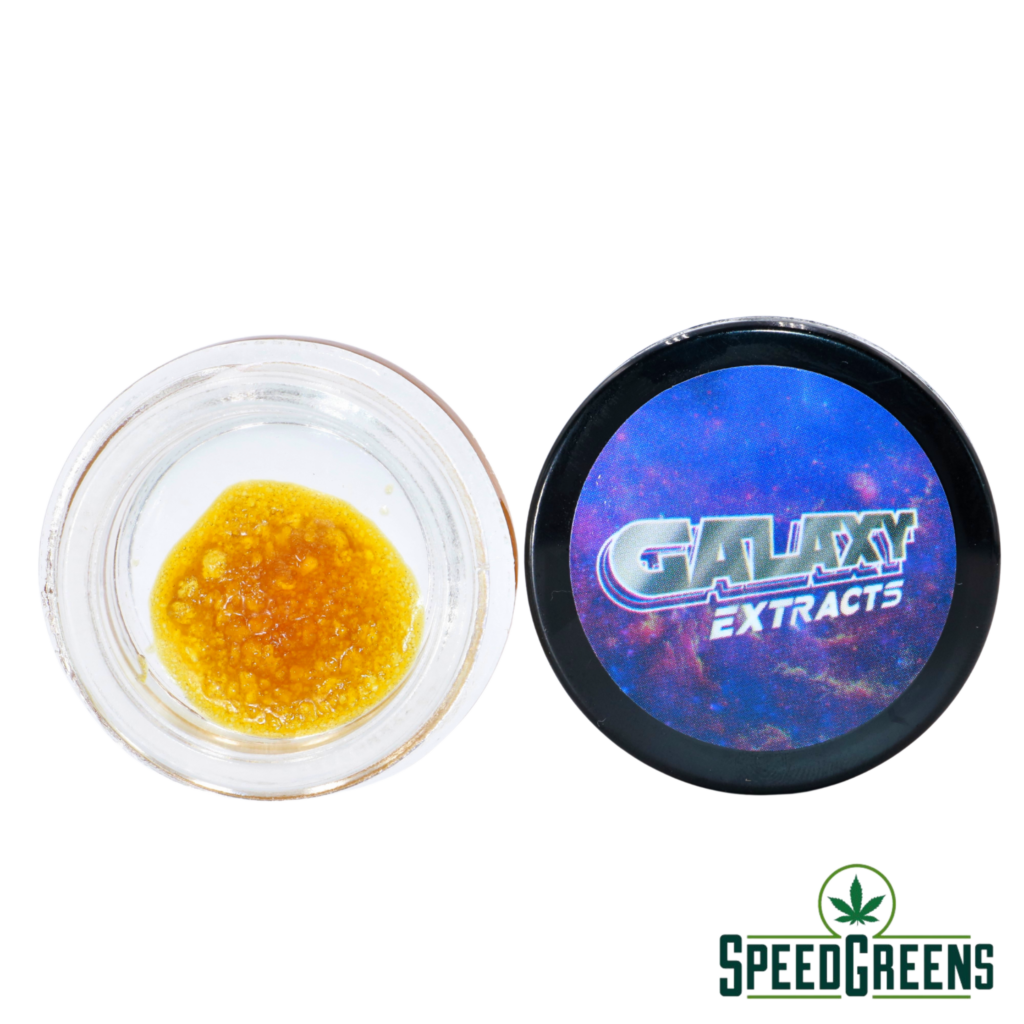
Weed smells because of two groups of airborne chemicals made in the plant's resin glands: terpenes, which carry most of the aroma, and a tiny family of sulfur compounds that carries the skunk. The skunk note in particular comes from one molecule, 3-methyl-2-butene-1-thiol, not from myrcene as is often claimed.[1] Below: what each group does, why a jar goes quiet over a few weeks, and what does and does not get the smell out of a room.
Key Takeaways
- The skunk smell is sulfur, not terpenes. A family of prenylated volatile sulfur compounds drives it, led by 3-methyl-2-butene-1-thiol.[1]
- The loud smell does not last. Those sulfur compounds peaked at the end of an 11-day cure and had dropped substantially ten days after the flower was jarred.[1]
- Terpenes fade too, just more slowly. Figures reported from a 1996 study put monoterpene loss at roughly 31% after a week, 45% after a month and 55% after three months in open storage.[3]
- The terpene list on a label is a weak guide to the smell. A 2025 study of 91 samples found that neither terpene nor sulfur profiles alone strongly predicted what trained tasters perceived.[4]
- Fresh air is the only reliable fix for a smelly room. Health Canada advises against ozone generators in homes.[7]
On this page
Where the smell comes from
The aroma is made and stored in the glandular trichomes, the tiny stalked glands that coat the flower. They hold the resin, and the resin holds the volatile compounds that reach your nose.[1] A 1976 storage study described those glands as "well filled, well closed containers" and found that losses fell when care was taken not to damage them.[5] That is the practical lesson in one line: anything that breaks, warms or airs out the glands lets the smell go.
Two families of compound do almost all of the work. Terpenes are present in quantity and give each strain its broad character: citrus, pine, pepper, earth. Volatile sulfur compounds are present at far lower concentrations, but the nose picks them up at far lower thresholds, so a trace of them is enough to make a jar smell loud.[1]
The skunk molecule
In 2021, researchers analysed 13 cannabis cultivars with two-dimensional gas chromatography and a detector tuned to sulfur. They found a previously unidentified family of prenylated volatile sulfur compounds, and named 3-methyl-2-butene-1-thiol as the main driver of the skunk-like aroma. The cultivar with the most of these compounds was also the one a trained panel rated most skunky.[1]
A 2022 study using gas chromatography with olfactometry, where a person sniffs each compound as it leaves the instrument, confirmed the same molecule as the skunky odorant and described it as intense and sulfuric even at extremely low concentrations.[2]
So the common claim that myrcene makes weed smell skunky does not hold. Myrcene is often the most abundant terpene in a sample, and it smells earthy and musky, but the skunk note belongs to a different class of molecule altogether. If you want strains people describe that way, browse skunky strains or diesel strains.
Terpenes: the rest of the aroma
Terpenes give a strain its citrus, pine or pepper character, and each one has its own page on Weedpedia: limonene, pinene, beta-caryophyllene, linalool and the rest.
What a terpene list cannot do is predict the smell with any precision. In a 2025 study, trained sensory panels described 91 cannabis samples while the samples' terpenes and sulfur compounds were measured in parallel. Terpinolene was the only compound consistently linked to particular descriptors, citrus and chemical, and neither the terpene profile nor the sulfur profile on its own strongly predicted what the panels perceived.[4] Aroma comes from the whole mixture, which is why two jars with similar labels can smell nothing alike.
Why weed loses its smell
Every compound behind the aroma is volatile: it evaporates. A sealed jar slows that down; it does not stop it.
The skunk goes first. In the 2021 study, plants were hung to cure and dry for 11 days, and the sulfur compounds reached their maximum at the end of that process. A final measurement ten days after the flower was jarred showed a substantial decrease in all of them.[1] That is why a freshly cured jar smells far louder than the same flower a month later.
Terpenes follow more slowly. A 2020 review reports figures from a 1996 study of roughly 31% monoterpene loss at one week, 45% at one month and 55% at three months in open storage.[3] Those numbers are second-hand and specific to that setup, but the direction is consistent: the lighter, more volatile terpenes leave first.
| What speeds up the loss | What the research found |
|---|---|
| Light | "The greatest single factor in loss of cannabinoids" in a two-year storage study[5] |
| Air | Air oxidation led to significant losses in the same study[5] |
| Warmth | In a four-year study, temperature changed only the speed of THC breaking down to CBN, while light changed both its speed and its products[6] |
| Rough handling | Losses could be reduced by taking care not to damage the resin glands[5] |
Note what those studies measured. The 1976 and 2019 work tracked cannabinoids, not aroma, so they tell you light and air are the main threats to potency. Neither measured the smell itself.
Keeping the smell in the jar
The short version: an airtight glass jar, ideally amber or opaque, kept in a cool, dark cupboard, with a two-way humidity pack. The relevant standard holds dry cannabis flower at a water activity of 0.55 to 0.65, which in a sealed jar is roughly 55% to 65% relative humidity; that is why the common humidity packs are 58% and 62%.[8]
One storage trick that does not work on its own: topping a jar up with argon. A 2020 study found argon displacement alone did not prevent terpene loss over six weeks.[3]
We cover storage in detail elsewhere, so this page stops there: how long weed lasts and how to store it, humidity control for bulk storage, and storing a pound long term.
Getting the smell out of a room
Cannabis smoke and aroma are a mix of many different molecules, and no single household device removes all of them. Here is what each common option actually does.
| Option | How it works | What to expect |
|---|---|---|
| Open a window, run an exhaust fan | Replaces the air | The most reliable fix |
| Activated carbon filter | Traps many airborne organic molecules on the carbon | Real effect, but independent data on cannabis odour from home units is thin; most figures come from sellers |
| HEPA air purifier | Filters particles, not gases | Helps with smoke particles, little effect on smell |
| Sprays, candles, diffusers | Add a stronger smell on top | Mask the smell for a while; remove nothing |
| Ozone generator | Releases ozone to react with odours | Not recommended in homes; see below |
Ozone generators: why not
Ozone generators are sold as air cleaners, and ozone does react with odour molecules. It also reacts with your lungs. Health Canada advises against using ozone generators in homes, noting they can also create other harmful chemicals, and lists coughing, irritated eyes, nose and throat, chest discomfort, shortness of breath and decreased lung function among the effects of ozone, with people who have breathing conditions more sensitive.[7] Its residential guideline sets a maximum indoor exposure of 20 ppb averaged over eight hours.[9]
What Canadian rules cover
Federal rules govern the package, not the smell in your home. Legal cannabis must be sold in an immediate container that keeps dried cannabis dry, has a security feature, meets the child-resistant standard in the Food and Drug Regulations, and holds no more than the equivalent of 30 grams of dried cannabis.[10] The 30-gram figure caps the size of the container; it is not a limit on what you keep at home.
The Cannabis Act also restricts how accessories are promoted, prohibiting representations that could create a false impression about an accessory's performance or safety.[11] Treat "100% smell proof" claims accordingly.
FAQ
Why does weed smell like skunk?
Is myrcene what makes weed smell skunky?
Why does my weed not smell as strong as when I bought it?
Can you tell what weed will smell like from its terpenes?
What is the best way to get rid of weed smell in a room?
Are ozone generators safe for weed smell?
References
- Oswald, I. W. H., et al. (2021). Identification of a New Family of Prenylated Volatile Sulfur Compounds in Cannabis Revealed by Comprehensive Two-Dimensional Gas Chromatography. ACS Omega, 6(47), 31667-31676. doi.org/10.1021/acsomega.1c04196
- Koziel, J. A., et al. (2022). "Skunky" Cannabis: Environmental Odor Troubleshooting and the "Need-for-Speed". ACS Omega. doi.org/10.1021/acsomega.2c00517
- Bueno, J., et al. (2020). The preservation and augmentation of volatile terpenes in cannabis inflorescence. Journal of Cannabis Research, 2, 27. doi.org/10.1186/s42238-020-00035-z
- Isaacson, S. E., et al. (2025). Beyond potency: A proposed lexicon for sensory differentiation of Cannabis sativa L. aroma. PLOS ONE, 20(10), e0335125. doi.org/10.1371/journal.pone.0335125
- Fairbairn, J. W., Liebmann, J. A., and Rowan, M. G. (1976). The stability of cannabis and its preparations on storage. Journal of Pharmacy and Pharmacology, 28(1), 1-7. doi.org/10.1111/j.2042-7158.1976.tb04014.x
- Zamengo, L., et al. (2019). The role of time and storage conditions on the composition of hashish and marijuana samples: A four-year study. Forensic Science International, 298, 131-137. doi.org/10.1016/j.forsciint.2019.02.058
- Health Canada. Ozone. canada.ca
- ASTM International. ASTM D8197: Standard Specification for Maintaining Acceptable Water Activity (aw) Range (0.55 to 0.65) for Dry Cannabis Flower Intended for Human/Animal Use. store.astm.org
- Health Canada. Residential Indoor Air Quality Guideline: Ozone. canada.ca
- Cannabis Regulations (SOR/2018-144), section 108. laws-lois.justice.gc.ca
- Cannabis Act (S.C. 2018, c. 16), sections 2(1), 17 and 18. laws-lois.justice.gc.ca
For adults 19+. General information, not medical advice. Keep cannabis locked away from children and pets.