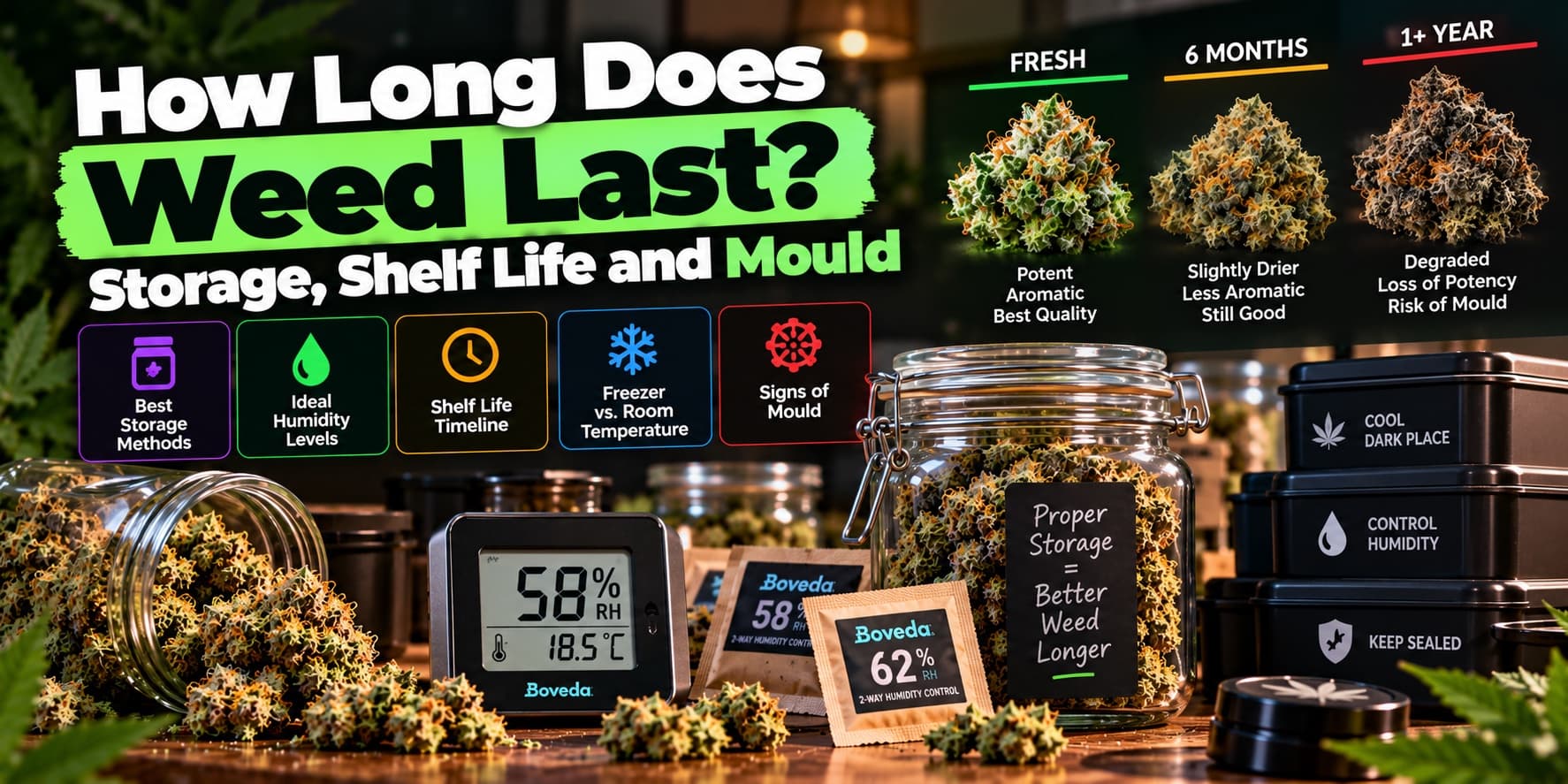
Properly stored dried cannabis keeps its character for six to twelve months and remains usable well beyond that. What degrades first is aroma, not safety. The four things that destroy it are light, oxygen, heat and the wrong humidity, and the research on each is clearer than the "cool, dark, dry, airtight" advice repeated on every packaging blog suggests.
Key Takeaways
- Light is the single worst factor. A classic stability study found light exposure the most destructive variable in storage.[1]
- Terpenes go before cannabinoids. Aroma fades first; potency declines more slowly.[2]
- Target a water activity of 0.55–0.65. That is the published specification for dried flower intended for human use.[3]
- Too dry is a real failure mode, not just too damp: brittle flower sheds trichomes and loses aroma fast.
- Mould risk is about moisture, not visible dust. Yeast and mould counts vary with genotype, environment and post-harvest handling.[4]
- Never smoke flower you suspect is mouldy: fungal contaminants in cannabis carry real health implications.[5]
How Long Does Weed Last?
There is no expiry date, only a decline curve, and how steep it is depends almost entirely on storage.
| Time stored well | What you notice |
|---|---|
| 0–3 months | Essentially unchanged: full aroma and effect |
| 3–6 months | Aroma beginning to flatten; effect largely intact |
| 6–12 months | Noticeably less aromatic; potency measurably lower but usable |
| 12 months+ | Significant terpene loss, drier, harsher, still not unsafe if it stayed dry |
Stored badly, a clear jar on a windowsill, or a bag opened daily: that curve compresses into weeks rather than months.
What Actually Degrades It
Light
Light is the most destructive single factor, and it has been known for decades. A 1976 stability study of cannabis and its preparations tested storage variables and found light exposure drove the fastest degradation of the cannabinoid content.[1]
This is why the fix is so cheap: an opaque container in a closed cupboard removes the worst variable entirely. A clear glass jar on a shelf, however airtight, does not.
Temperature
Cool and stable beats cold and fluctuating. Room temperature in a dark cupboard, roughly 15–21°C, is fine. Heat accelerates terpene loss and cannabinoid breakdown, so the cupboard above the stove is the worst spot in most kitchens.
Work profiling cannabis under different post-harvest storage conditions found the chemical profile shifts measurably depending on how it is kept,[2] with terpenes, the volatile fraction, moving first.
The freezer is a qualified yes and the fridge is usually a no. Freezing makes trichomes brittle enough to snap off if the flower is handled, and fridges cycle both temperature and humidity every time the door opens, which invites condensation. See storing a pound long term for the detail.
Humidity and Water Activity
This is where most people get it wrong in both directions. Too damp and you create conditions for microbial growth. Too dry and the flower turns brittle, sheds trichomes and loses its aroma.
The industry reference is not relative humidity but water activity: the moisture actually available to microbes rather than total water content. ASTM specifies a range of 0.55 to 0.65 for dry cannabis flower intended for human or animal use.[3] Our explainer on water activity in dried flower covers why laboratories measure it instead of moisture percentage.
In practical terms that corresponds to roughly 55–65% relative humidity inside a sealed container. Humidity control for bulk storage covers packs, hygrometers and why a Canadian winter home sits far below that band.
The Best Container
| Container | Verdict |
|---|---|
| Opaque glass jar with a gasket | Best all-round: airtight, inert, blocks light |
| Clear glass jar in a dark cupboard | Fine, provided the cupboard genuinely stays shut |
| Vacuum-sealed bag | Good for long-term reserve; crushes delicate flower |
| Plastic bag or baggie | Poor: static strips trichomes, seals badly |
| Grinder | Not storage. Ground flower degrades far faster |
Fill the jar. Headspace is oxygen, and a half-empty jar ages its contents faster than a full one of the same size.
How to Tell If It Has Mould
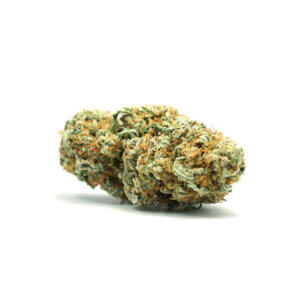
Mould on cannabis is usually white or grey, fuzzy and web-like, and it sits on top of the surface rather than in it. Trichomes are crystalline and sparkle under light; mould is dull and fibrous.
- Smell: musty, like a damp basement, instead of the strain's aroma. This is often the first sign.
- Grey or white fuzz in the crevices between bud leaves.
- Dark spots or discolouration that was not there before.
- Dampness or sponginess in flower that was previously springy.
If you suspect mould, do not smoke it. Fungal and mycotoxin contaminants in cannabis and hemp carry documented implications for consumer health, and heat does not reliably neutralise them.[5] There is no salvage step worth the risk.
Canada's Mould Limits
Health Canada publishes microbial testing limits for dried cannabis that licensed producers must meet before release.[6] Those limits apply at the point of sale in the legal market. They say nothing about what happens in your cupboard afterwards.
Research on total yeast and mould levels in high-THC inflorescences found counts are influenced by genotype, growing environment and post-harvest processing,[4] which is a reminder that flower does not arrive sterile. Storage decides whether what is present stays dormant.
Does Old Weed Turn Into CBN?
Partly, and more slowly than the internet suggests. THC oxidises to CBN over time, which is why very old flower is often described as more sedating. But the conversion is gradual, incomplete, and accompanied by overall cannabinoid loss rather than a clean swap.
Deliberately ageing flower to produce CBN is not a reliable strategy: you lose aroma and total potency to gain a modest amount of a different cannabinoid.
The Most Common Mistakes
- Clear jar on a visible shelf. Looks good, breaks the single most important rule.
- Storing it in the fridge. Humidity cycling and condensation every time the door opens.
- Grinding ahead of time. Surface area is the enemy; grind what you are about to use.
- A half-empty large jar. All that headspace is oxygen.
- Chasing a number with no instrument. Guessing humidity is how flower ends up at 40% or 75%.
- Opening the jar constantly. Every opening resets the internal environment. Decant a working amount and leave the reserve sealed.
Where to Buy
Storage matters most when you buy at volume. These dispensaries sell by the ounce and above, and ship free over $150:
FAQ
How long does weed last?
Does weed expire or go bad?
What is the best way to store weed?
Should you store weed in the fridge or freezer?
How can you tell if weed has mould on it?
Is mouldy weed dangerous?
Does old weed get you higher because of CBN?
Can you store weed in a plastic bag?
References
- Fairbairn, J. W., Liebmann, J. A., & Rowan, M. G. The stability of cannabis and its preparations on storage. Journal of Pharmacy and Pharmacology, 1976, 28(1), 1–7. DOI: 10.1111/j.2042-7158.1976.tb04014.x
- Milay, L., Berman, P., Shapira, A., Guberman, O., & Meiri, D. Metabolic Profiling of Cannabis Secondary Metabolites for Evaluation of Optimal Postharvest Storage Conditions. Frontiers in Plant Science, 2020, 11:583605. DOI: 10.3389/fpls.2020.583605
- ASTM International. ASTM D8197-22: Standard Specification for Maintaining Acceptable Water Activity (aw) Range (0.55 to 0.65) for Dry Cannabis Flower Intended for Human/Animal Use. 2022. astm.org
- Punja, Z. K., Ni, L., Lung, S., & Buirs, L. Total yeast and mold levels in high THC-containing cannabis (Cannabis sativa L.) inflorescences are influenced by genotype, environment, and pre- and post-harvest handling practices. Frontiers in Microbiology, 2023.
- Gwinn, K. D., Leung, M. C. K., Stephens, A. B., & Punja, Z. K. Fungal and mycotoxin contaminants in cannabis and hemp flowers: implications for consumer health and directions for further research. Frontiers in Microbiology, 2023.
- Health Canada. Heavy metal and microbial testing limits for dried cannabis. Government of Canada. canada.ca
This article is for informational and harm-reduction purposes only and is not medical advice. If you suspect cannabis has mould on it, discard it rather than attempting to salvage it. Storage outcomes vary with container, climate and starting moisture content. Follow the cannabis laws applicable in your jurisdiction. 19+.