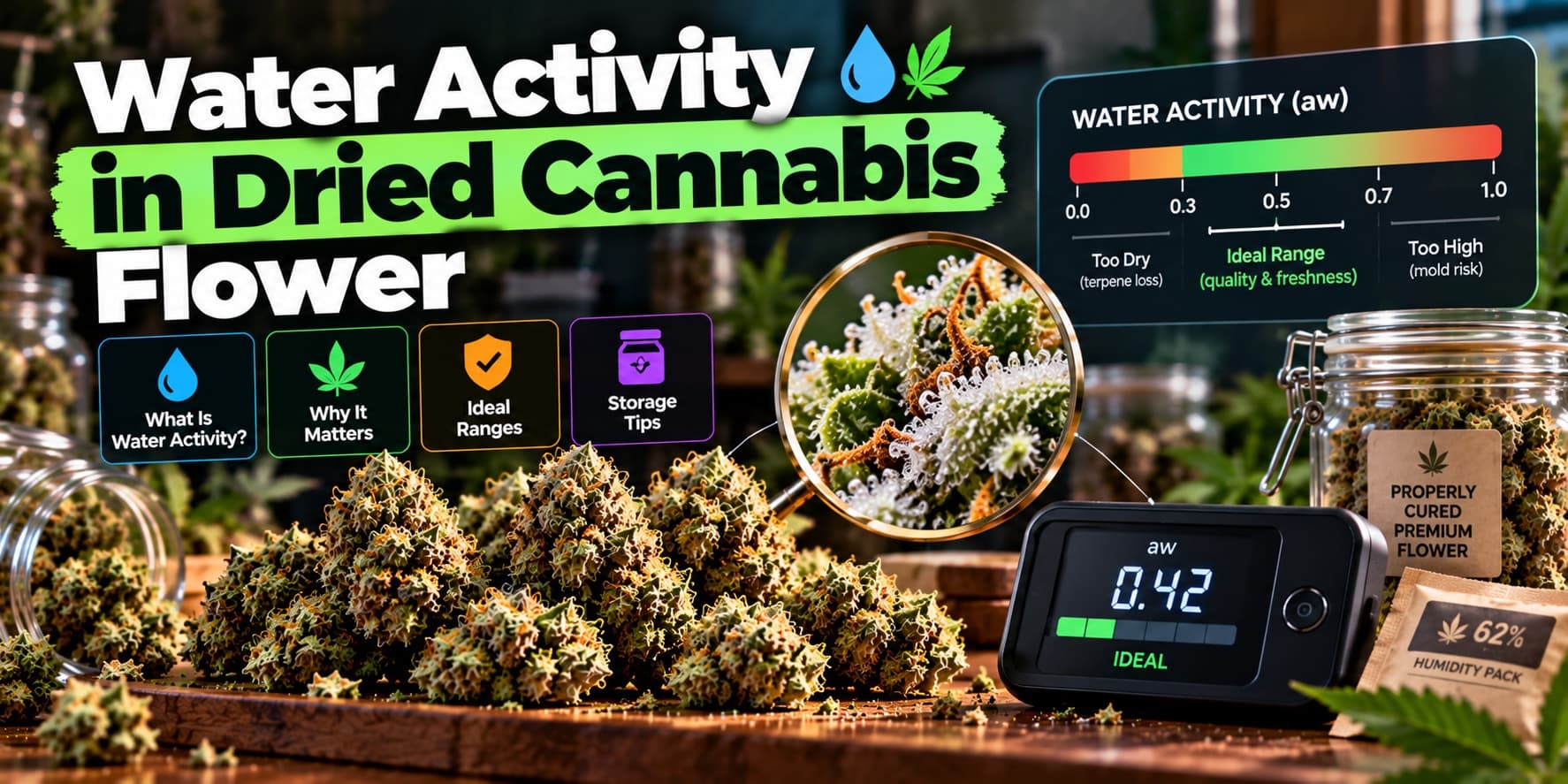
Water activity measures the moisture in cannabis that is actually available to microbes, not how much water the flower contains. That distinction is why laboratories measure it instead of moisture percentage, and why the published storage specification for dried flower is a water activity of 0.55 to 0.65 rather than a moisture content figure.
Key Takeaways
- Water activity (aw) runs from 0 to 1 and describes available moisture, not total moisture.
- The target band is 0.55–0.65 for dry cannabis flower intended for human use.[1]
- It is not the same as moisture content, and the two cannot be reliably converted into one another.
- Microbes respond to aw, not to moisture percentage, which is exactly why food safety regulation defines it.[3]
- A jar hygrometer is a rough proxy. Equilibrium relative humidity divided by 100 approximates aw, but only at equilibrium.
- Canada does not set an aw limit for cannabis; it sets microbial limits instead.[6]
What Water Activity Is
Water activity is the ratio of the water vapour pressure above a material to the vapour pressure of pure water at the same temperature. It is a dimensionless number between 0 and 1. Pure water is 1.00, and a completely desiccated material approaches 0.
The useful intuition: it describes how readily water will leave the material. Some of the water in a cannabis bud is chemically bound up in plant tissue and unavailable; some sits free and can evaporate, migrate, or support microbial growth. Water activity measures only the second kind.
The concept comes from food science, where it is defined in regulation: the US Food and Drug Administration's definition in 21 CFR 113.3 is the standard reference,[2] and it has been used for decades to predict microbial stability in foods.[3][4]
Water Activity vs Moisture Content
This is the heart of it. Moisture content tells you how much water is present; water activity tells you how much of it is doing anything. Two buds at 12% moisture can sit at different water activities depending on how that water is bound, and it is the water activity that determines whether microbes can use it.
The Target Band
0.55 to 0.65. ASTM publishes this as the specification for maintaining acceptable water activity in dry cannabis flower intended for human or animal use,[1] with a companion standard covering how the measurement should actually be taken.[5]
| Water activity | Condition |
|---|---|
| Below 0.50 | Over-dry: brittle, trichome loss, aroma gone |
| 0.50–0.55 | Dry side of acceptable |
| 0.55–0.65 | Target band: pliable and microbially stable |
| 0.65–0.70 | Damp side: short-term only |
| Above 0.70 | Microbial growth becomes possible |
The upper bound is not arbitrary. Most spoilage moulds need water activity above roughly 0.70 to grow, so the band is set to leave margin beneath that while keeping flower from going brittle.
Can You Convert Between Them?
Not reliably. The relationship between moisture content and water activity is specific to the material and is described by a sorption isotherm, a curve that differs by cultivar, density, cure and temperature.
You will see rules of thumb pairing "about 10–12% moisture" with "0.55–0.65 aw" for cannabis, and as an orientation that is roughly right. As a conversion it is not dependable: two batches at the same moisture percentage can sit either side of the safe threshold. If the number matters, measure the one you actually care about.
Why Laboratories Measure It
Because microbes respond to available water, and nothing else predicts them as well. Water activity has been the standard tool for predicting microbial stability in food for decades,[3][4] and cannabis inherited the method along with the problem.
Research on total yeast and mould levels in high-THC inflorescences found counts are influenced by genotype, growing environment and pre- and post-harvest handling[7], and work on post-harvest drying and curing shows those stages set the microbial starting point.[8] Water activity is the single measurement that tells a lab whether what is present can multiply.
It is also faster and non-destructive compared with oven-drying a sample to determine moisture content, which matters when every batch needs testing.
Does a Jar Hygrometer Measure It?
Approximately, and better than most people assume. At equilibrium in a sealed container, the relative humidity of the air equals the water activity of the contents multiplied by 100. A settled jar reading 60% RH indicates a water activity of about 0.60.
Three caveats keep it an approximation rather than a measurement:
- It must be at equilibrium. Read too soon after sealing or after opening and the number is meaningless. See humidity control for bulk storage on why a jar's reading climbs after filling.
- Temperature must be consistent. Both measurements are temperature-dependent.
- Consumer hygrometers drift. A meter a few points out will put you on the wrong side of the line without telling you.
The practical upshot: a cheap hygrometer in a sealed jar is a perfectly reasonable way to manage home storage. It is not a laboratory measurement, and it should not be quoted as one.
Does Canada Set a Limit?
No: Health Canada regulates the outcome rather than the mechanism. There is no water activity limit in the Cannabis Regulations. What exists is microbial testing limits that dried cannabis must meet before it is released for sale,[6] alongside packaging and labelling requirements.[9]
Producers use water activity as the control that keeps them inside those microbial limits. It is an industry process control, not a legal threshold, which is also why you will rarely see it printed on a label.
What a Bulk Buyer Should Do
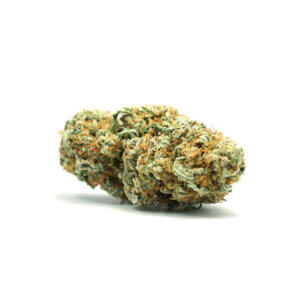
- Judge the cure by hand on arrival. Flower in band springs back when squeezed; it neither crumbles nor feels spongy.
- Put a hygrometer in each jar and read it once the jar has settled for a day.
- Aim for 55–65% and, above all, keep it steady. Fluctuation does its own damage.
- Ask the retailer whether they test water activity. Those that do tend to be the ones controlling their cure properly.
- Err dry if you must err. Over-dry flower loses quality; over-damp flower becomes unusable.
At pound scale this is worth real money: the reasoning and the jar maths are in storing a pound of weed long term.
Where to Buy
Canadian dispensaries selling at the weights where cure quality matters most, all shipping free over $150:
FAQ
What is water activity in weed?
What water activity should dried cannabis be stored at?
What is the difference between water activity and moisture content?
Can you convert water activity to a moisture percentage?
Why do laboratories measure water activity instead of moisture?
Does a jar hygrometer measure water activity?
Does Canada set a water activity limit for cannabis?
References
- ASTM International. ASTM D8197-22: Standard Specification for Maintaining Acceptable Water Activity (aw) Range (0.55 to 0.65) for Dry Cannabis Flower Intended for Human/Animal Use. 2022. astm.org
- United States Food and Drug Administration. 21 CFR 113.3: Definitions (water activity). Code of Federal Regulations. ecfr.gov
- United States Food and Drug Administration. Water Activity (aw) in Foods, Inspection Technical Guide No. 39. 1984. fda.gov
- Commonwealth Scientific and Industrial Research Organisation. Water Activity. Division of Food Science and Technology fact sheet, 1995.
- ASTM International. ASTM D8196-20: Standard Practice for Determination of Water Activity (aw) in Cannabis Flower. 2020. astm.org
- Health Canada. Heavy metal and microbial testing limits for dried cannabis. Government of Canada. canada.ca
- Punja, Z. K., Ni, L., Lung, S., & Buirs, L. Total yeast and mold levels in high THC-containing cannabis (Cannabis sativa L.) inflorescences are influenced by genotype, environment, and pre- and post-harvest handling practices. Frontiers in Microbiology, 2023.
- Baek, Y., Grab, H., & Chen, C. Postharvest Drying and Curing Affect Cannabinoid Contents and Microbial Levels in Industrial Hemp (Cannabis sativa L.). Plants, 2025, 14(3):414. DOI: 10.3390/plants14030414
- Health Canada. Packaging and labelling guide for cannabis products. Government of Canada. canada.ca
This article is for informational purposes only and is not medical advice. Water activity figures and storage bands are industry specifications, not legal requirements in Canada. Consumer hygrometer readings approximate water activity only at equilibrium and are not laboratory measurements. If you suspect cannabis has mould on it, discard it. 19+.