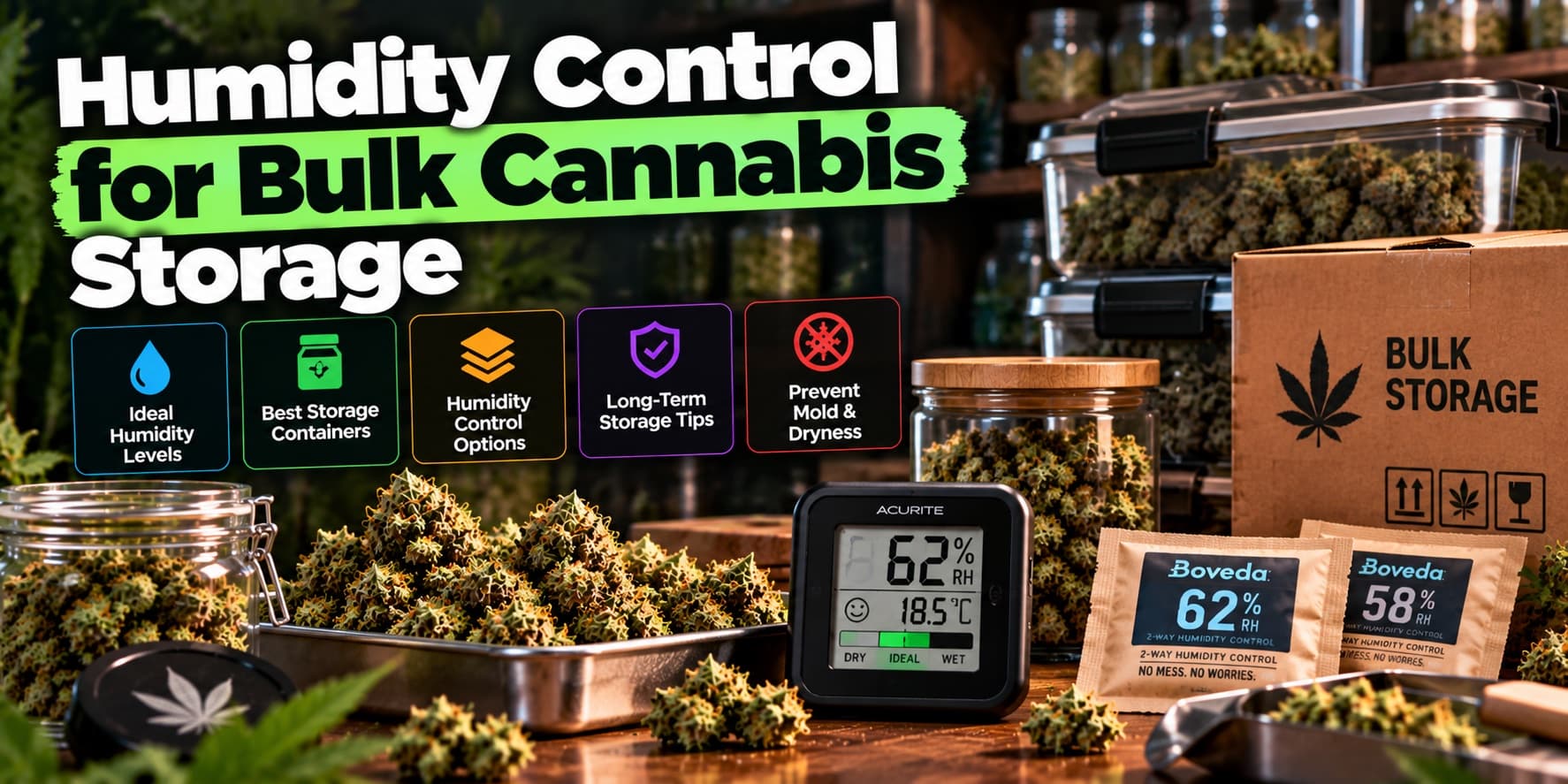
Bulk cannabis should be held at 55–65% relative humidity inside the container, and in a Canadian winter the room around it will sit far below that. Heating a house in January drives indoor humidity down to roughly 30%, which is why an unmanaged jar dries out between December and March no matter how good the seal is.
Key Takeaways
- Target 55–65% inside the jar, corresponding to the published water activity range of 0.55–0.65 for dried flower.[1]
- Canadian winter indoor humidity sits near 30%. Natural Resources Canada's guidance caps recommended indoor humidity far below the storage band when it is cold outside.[2]
- Only the jar's humidity matters, but the room decides how hard the jar has to work, and how fast it loses the fight when opened.
- Stability beats precision. Fluctuation is more damaging than sitting a few points off target.[3]
- Too humid risks microbial growth; elevated humidity has also been associated with reduced cannabinoid concentration in cannabis.[4]
- Size humidity packs to the jar, not to the pound. One small pack in a large jar does nothing useful.
The Storage Band
55 to 65 percent, measured inside the sealed container. That band maps onto the ASTM specification for maintaining water activity between 0.55 and 0.65 in dry cannabis flower intended for human use.[1] Our explainer on water activity in dried flower covers why the two numbers line up.
| Jar humidity | What happens |
|---|---|
| Below 50% | Brittle flower, trichomes shed on handling, aroma gone |
| 50–55% | Dry side of acceptable: harsher, but stable |
| 55–65% | Target band (pliable, aromatic, microbially stable |
| 65–70% | Damp side), tolerable briefly, risky long term |
| Above 70% | Microbial growth territory. Do not store here |
Does the Room Matter, or Only the Jar?
Strictly, only the jar, but the room decides how hard that is to maintain. A sealed container with a humidity pack will hold its band against a dry room. The difficulty is that no seal is perfect and no jar stays shut forever.
This is where Canadian winters cause trouble. Natural Resources Canada's home-heating guidance sets recommended indoor relative humidity by outdoor temperature, and once it is properly cold the recommended maximum drops to around 30% to avoid condensation damage to the building.[2] A house doing the right thing for its windows is running at half the humidity your flower wants.
Why a Sealed Jar's Humidity Rises
Because moisture inside the bud migrates outward until the jar reaches equilibrium. Fill a jar with flower that reads 58% on a meter in open air, seal it, and the reading climbs over the following hours: the dense interior of each bud is wetter than its surface, and that water redistributes into the enclosed air.
The practical consequence: take your reading after the jar has been sealed and settled, not at the moment you fill it. Give it a day. A jar that reads 62% immediately may settle at 68%, which is a different decision.
Post-harvest drying and curing set the starting point here: research on how those stages affect cannabinoid content and microbial levels shows the condition flower arrives in determines how much work your storage has to do.[5]
If It Is Stored Too Humid
Above about 70%, you are in microbial territory. That is the failure mode that makes flower unsafe rather than merely disappointing, and it is not reversible. See how to spot mould and what Canada's limits are.
There is a quality cost short of that too. Research on cannabis grown under elevated relative humidity found significantly decreased cannabinoid concentrations,[4] and fungal and mycotoxin contaminants in cannabis flower carry documented implications for consumer health.[6] Damp is the expensive direction to be wrong in.
What It Costs If a Pound Dries Out
Dry is cheaper than damp but not free. A pound of AAAA flower runs about $1,500, and flower that falls below 50% humidity loses most of what you paid the premium for:
- Aroma. Terpenes are volatile and leave with the moisture.
- Trichomes: brittle flower sheds them into the bottom of the jar every time it is handled.
- Smoothness: over-dry flower burns hot and harsh.
- Weight. You are also, literally, left with less of it.
The asymmetry worth remembering: too dry degrades value, too damp destroys it. If you are going to miss the band, miss it on the dry side.
Do Humidity Packs Work for a Pound?
Yes, if you size them to the container. Two-way humidity packs hold a set point by absorbing or releasing moisture, and they work well, but each has a finite capacity, and that capacity is matched to a volume of air and flower.
| Portion | Approach |
|---|---|
| Up to an ounce | One small pack per jar |
| Quarter pound | Large pack, or several small, per jar |
| A full pound | Split into four to eight jars, each with its own pack |
One pack in a pound-sized vessel is doing a job several times its capacity. Splitting the pound is better for humidity and better for oxygen exposure at the same time. The reasoning is in storing a pound long term.
Packs are consumable. When one goes rigid it is spent; when it goes soggy it is saturated. Replace rather than revive.
Measuring Humidity Inside the Jar
- Use a small digital hygrometer inside the container, an external reading tells you about the room, not the flower.
- Let it equalise for several hours after sealing, and longer after adding flower.
- Read it before opening, not after. The number starts moving the moment the lid lifts.
- Check it against a known reference occasionally. Cheap hygrometers drift, and a meter reading 5 points high will walk your flower into the damp zone.
- Read at a consistent temperature. Relative humidity is temperature-dependent, so a cold jar and a warm one are not comparable.
Steady Beats Exact
A jar held steadily at 58% is in better shape than one swinging between 50% and 68%. Conservation guidance on incorrect relative humidity treats fluctuation as a damage mechanism in its own right, separate from the absolute level.[3] Repeated cycling moves moisture in and out of the material each time.
Which is a useful reframing: the goal is not to hit a number, it is to stop the number moving. A cupboard at stable room temperature, jars that stay shut, and packs replaced before they fail will do more than chasing 60% exactly.
Where to Buy
Bulk flower from Canadian dispensaries, all shipping free over $150:
FAQ
What humidity should cannabis be stored at?
Does the room's humidity matter or only the jar's?
Why does a sealed jar's humidity rise after filling?
Do humidity packs work for a pound of weed?
How do you measure humidity inside a storage jar?
Is steady humidity more important than the exact number?
What happens if weed is stored too dry?
References
- ASTM International. ASTM D8197-22: Standard Specification for Maintaining Acceptable Water Activity (aw) Range (0.55 to 0.65) for Dry Cannabis Flower Intended for Human/Animal Use. 2022. astm.org
- Natural Resources Canada. Keeping the Heat In: Chapter 9: Operating Your House, Table 9-1. Government of Canada. natural-resources.canada.ca
- Canadian Conservation Institute. Agent of deterioration: incorrect relative humidity. Government of Canada, 2017 (modified 2021). canada.ca
- Corredor-Perilla, I. C., Kwon, T.-H., & Park, S.-H. Elevated relative humidity significantly decreases cannabinoid concentrations while delaying flowering development in Cannabis sativa. 2024.
- Baek, Y., Grab, H., & Chen, C. Postharvest Drying and Curing Affect Cannabinoid Contents and Microbial Levels in Industrial Hemp (Cannabis sativa L.). Plants, 2025, 14(3):414. DOI: 10.3390/plants14030414
- Gwinn, K. D., Leung, M. C. K., Stephens, A. B., & Punja, Z. K. Fungal and mycotoxin contaminants in cannabis and hemp flowers: implications for consumer health and directions for further research. Frontiers in Microbiology, 2023.
This article is for informational and harm-reduction purposes only and is not medical advice. If you suspect cannabis has mould on it, discard it rather than attempting to salvage it. Humidity readings vary with temperature and instrument accuracy. Prices referenced are those listed at time of writing. 19+.