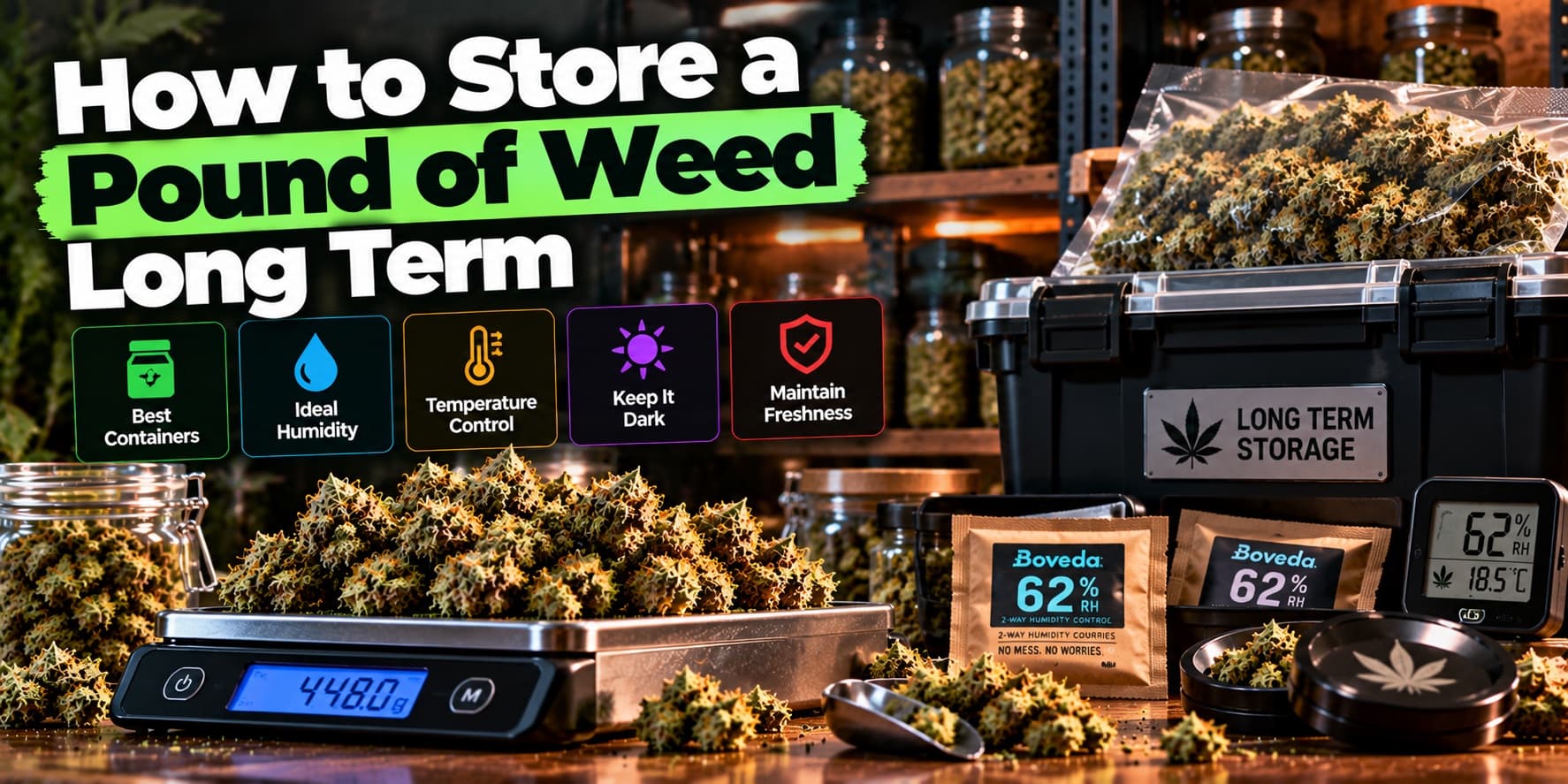
Split it into portions, seal each one in an opaque airtight jar with as little headspace as possible, hold the humidity at 55–65%, and leave the reserve jars shut. The mistake that costs people money is not the container. It is keeping a pound in one vessel and opening it every day, which exposes the whole quantity to oxygen and humidity swings every single time.
Key Takeaways
- Portion it. One working jar, the rest sealed. Opening a single large jar ages all 448 g at once.
- A four-year study found storage conditions drive composition change more than elapsed time alone.[1]
- Nitrogen flushing has been studied for cannabis and shows promise for retaining volatile terpenes.[2]
- Freezer beats fridge for long-term reserve, but only if the flower is not handled while frozen.
- Badly stored, a $1,500 pound can lose hundreds of dollars of value without ever becoming unsafe.
- A pound exceeds the 30 g public possession limit. It is a storage purchase, not a carrying one.
How to Store a Pound
- Divide into four to eight portions. One becomes the working jar; the rest go untouched into reserve.
- Use opaque airtight glass with a gasket seal. Light is the most destructive variable in cannabis storage.[3]
- Fill each jar. Headspace is oxygen, a full jar ages more slowly than a half-empty one of the same size.
- Add a humidity pack sized to the jar, targeting the 55–65% band.
- Store cool, dark and stable. A cupboard at steady room temperature beats anywhere that swings.
- Label each jar with the date it was sealed, so you work through them in order.
How Long Will It Keep?
Stored this way, a pound holds its character for six to twelve months, and remains usable well past that. A four-year study tracking hashish and marijuana samples found that composition change over time depends heavily on the conditions they were held in, not on elapsed time alone.[1]
Work profiling cannabis under different post-harvest storage conditions found the same pattern: the volatile terpene fraction moves first and fastest, with cannabinoids following more slowly.[4] In practice you notice aroma loss long before you notice reduced effect. Our guide to shelf life and storage covers the full decline curve.
Why Split It Into Jars?
Because every time you open a container, you replace its atmosphere. A pound in one jar that gets opened daily for six months has had its entire contents exposed to fresh oxygen and ambient humidity roughly 180 times. The same pound in eight jars, with seven sealed, has exposed one eighth of itself.
The rule of thumb: portion so the working jar holds about two weeks' supply. It will be near-empty by the time you open the next one, which also means less headspace over its life.
Vacuum Sealing and Nitrogen
Vacuum sealing works well for reserve portions and badly for flower you care about the look of. Pulling a vacuum compresses buds and strips trichomes against the bag wall. For material heading to extraction or edibles that is irrelevant; for presentation flower it is not.
Nitrogen flushing is the better version of the same idea. Research on nitrogen-modified atmosphere packaging for stored cannabis inflorescence examined exactly this question, displacing oxygen to retain volatile terpenes and cannabinoids, and found it a useful tool for retention.[2] It replaces the oxygen without crushing the flower.
For most people buying a pound, a filled opaque jar with a humidity pack gets the bulk of the benefit at none of the equipment cost.
Freezer vs Fridge
| Method | Verdict |
|---|---|
| Cool dark cupboard | Best for anything you will use within a year |
| Freezer | Workable for long reserve, but do not handle while frozen, and let jars reach room temperature before opening |
| Fridge | Avoid. Temperature and humidity cycle on every door opening, inviting condensation |
The freezer caveat matters. Frozen trichomes are brittle and snap off at a touch, so a jar that gets shaken or decanted cold loses exactly the fraction you were trying to preserve. If you freeze, freeze portions you will thaw whole.
The Six-Month Check
When you open a reserve jar after months, check in this order:
- Smell first. Strain aroma means it is fine. Musty or like a damp basement means stop.
- Look for fuzz: white or grey, fibrous rather than crystalline, in the crevices.
- Squeeze a bud. It should spring back. Crumbling means too dry; sponginess means too damp.
- Check the hygrometer if the jar has one, before the reading equalises with the room.
If you suspect mould, discard it. Fungal and mycotoxin contaminants in cannabis carry documented health implications and combustion does not reliably neutralise them.[5]
What Bad Storage Actually Costs
A pound of AAAA flower currently runs about $1,500. Put against that, the arithmetic of storage is blunt:
| Outcome | Value impact on a $1,500 pound |
|---|---|
| Stored well: aroma intact | Full value |
| Dried out and harsh, still usable | Materially reduced. It becomes extraction material |
| One jar in eight goes mouldy | About $188 discarded |
| Whole pound stored in one jar and spoils | $1,500 discarded |
That last row is the argument for portioning in a single line. The jars cost a few dollars; the downside they cap is the entire purchase.
Storing It Safely and Legally
There is no federal limit on how much cannabis you may keep at home in Canada, but the 30 g public possession limit means a pound is a storage purchase rather than something you carry.[6] Provinces may add their own rules.
Health Canada's guidance on safe storage is worth following regardless of quantity: keep it out of reach of children and pets, and store it where it cannot be mistaken for something else.[7] At pound scale, a lockable cupboard is sensible.
Where to Buy
Pound-tier flower from Canadian dispensaries, all shipping free over $150:
FAQ
How do you store a pound of weed long term?
How long will a pound of weed keep?
Why split a pound into separate jars?
Should you vacuum seal weed?
Is the freezer better than the fridge for storing weed?
What should you check when opening a jar after six months?
Is it legal to keep a pound of weed in Canada?
References
- Zamengo, L., Bettin, C., Badocco, D., Di Marco, V., Miolo, G., & Frison, G. The role of time and storage conditions on the composition of hashish and marijuana samples: A four-year study. Forensic Science International, 2019.
- MacLaughlin, L. L., & MacDonald, M. T. Is nitrogen-modified atmosphere packaging a tool for retention of volatile terpenes and cannabinoids in stored Cannabis sativa inflorescence? Journal of Cannabis Research, 2024.
- Fairbairn, J. W., Liebmann, J. A., & Rowan, M. G. The stability of cannabis and its preparations on storage. Journal of Pharmacy and Pharmacology, 1976, 28(1), 1–7. DOI: 10.1111/j.2042-7158.1976.tb04014.x
- Milay, L., Berman, P., Shapira, A., Guberman, O., & Meiri, D. Metabolic Profiling of Cannabis Secondary Metabolites for Evaluation of Optimal Postharvest Storage Conditions. Frontiers in Plant Science, 2020, 11:583605. DOI: 10.3389/fpls.2020.583605
- Gwinn, K. D., Leung, M. C. K., Stephens, A. B., & Punja, Z. K. Fungal and mycotoxin contaminants in cannabis and hemp flowers: implications for consumer health and directions for further research. Frontiers in Microbiology, 2023.
- Health Canada. Cannabis Act (S.C. 2018, c. 16): public possession limits. laws-lois.justice.gc.ca
- Health Canada. Safe storage of cannabis. Government of Canada. canada.ca
This article is for informational and harm-reduction purposes only and is not medical or legal advice. If you suspect cannabis has mould on it, discard it. Storage outcomes vary with container, climate and starting moisture content. Prices referenced are those listed at time of writing. Keep cannabis secured and out of reach of children and pets. 19+.