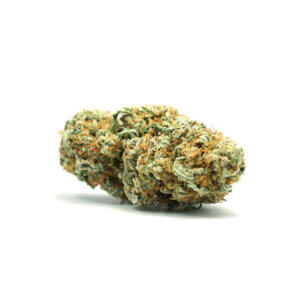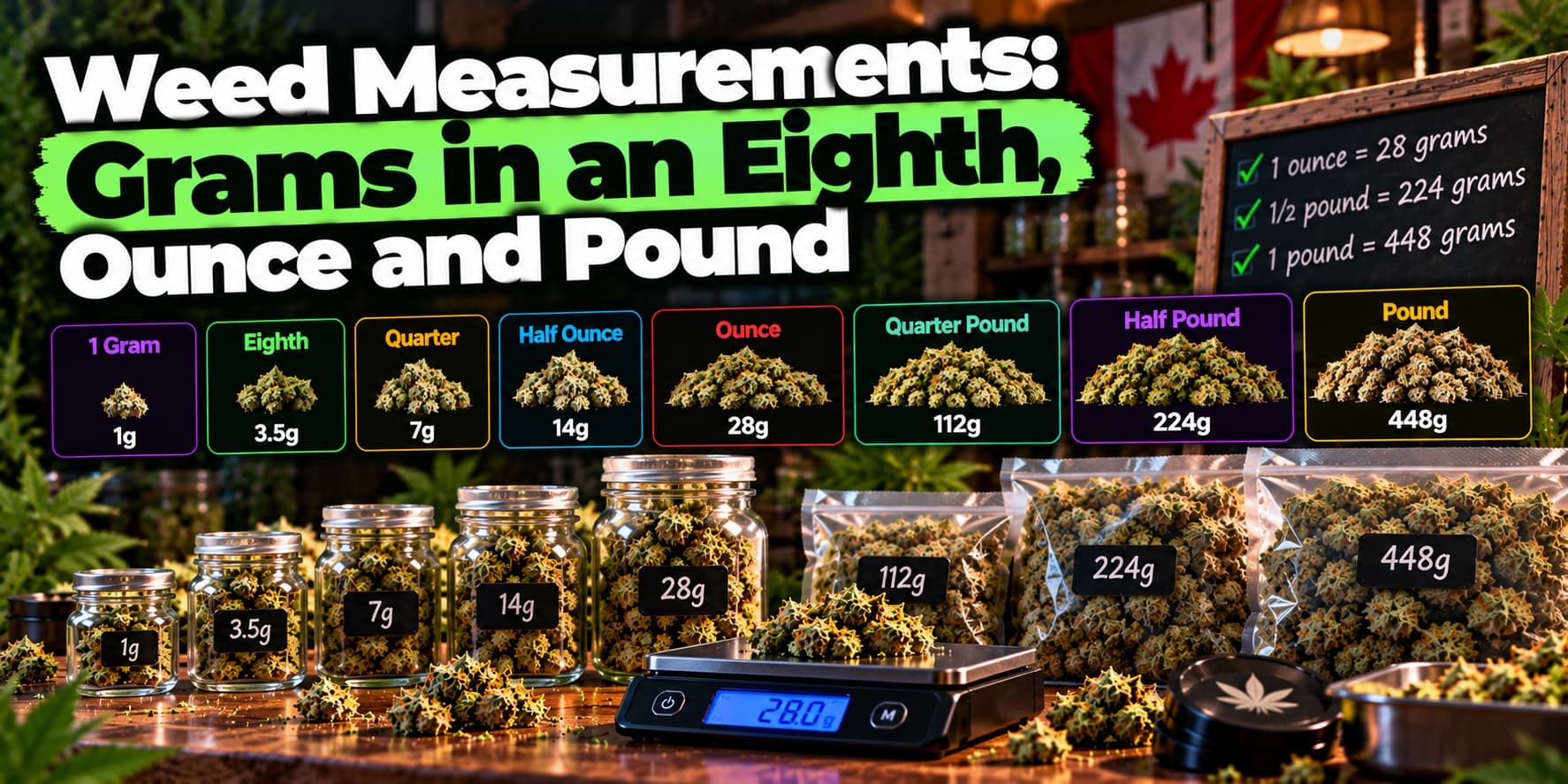
An eighth is 3.5 grams, a quarter is 7 grams, a half ounce is 14 grams and an ounce is 28 grams. Those are the rounded retail figures every Canadian dispensary uses. The exact conversions run slightly higher, a true ounce is 28.35 g, and the gap between the two is worth understanding before you weigh anything yourself.
Key Takeaways
- Eighth 3.5 g · quarter 7 g · half ounce 14 g · ounce 28 g. Retail rounds down from the imperial values.
- A retail pound is 448 g, not 453.6 g, because it is sold as 16 × 28 g rather than a true imperial pound.
- An ounce makes roughly 87 joints at the peer-reviewed average joint weight of 0.32 g.[1]
- A package may legally weigh slightly less than its label. Health Canada allows 10% tolerance at 2 g or under and 5% above 2 g.[2]
- You need a 0.01 g scale. A kitchen scale reading in whole grams cannot resolve an eighth meaningfully.
- Canada's 30 g limit is a dried equivalent: 30 g of dried flower equals 150 g fresh or 450 g of edible product.[4]
The Conversion Chart
| Name | Fraction | Retail grams | Exact grams |
|---|---|---|---|
| Gram | : | 1 g | 1 g |
| Eighth | ⅛ oz | 3.5 g | 3.54 g |
| Quarter | ¼ oz | 7 g | 7.09 g |
| Half ounce | ½ oz | 14 g | 14.17 g |
| Ounce | 1 oz | 28 g | 28.35 g |
| Quarter pound | 4 oz | 112 g | 113.40 g |
| Half pound | 8 oz | 224 g | 226.80 g |
| Pound | 16 oz | 448 g | 453.59 g |
Why 28 Grams and Not 28.35
Cannabis is sold in imperial fractions but weighed in metric, and the industry rounds down at every step. An ounce is 28.3495 grams. Retail calls it 28. Over a pound that rounding compounds: sixteen 28-gram ounces come to 448 g, while a true imperial pound is 453.59 g, a gap of about 5.6 g, roughly an eighth and a half.
What this means in practice: when someone quotes you a per-gram price on a pound, check which pound they mean. The same dollar figure divided by 448 or by 453.59 gives you two different numbers, and the retail convention is almost always 448.
How Many Joints Are in an Ounce?
About 87. The number that matters here is the average amount of cannabis in a joint, and it has actually been measured: a 2016 study in Drug and Alcohol Dependence applied Bayesian inference to arrive at a mean of 0.32 grams per joint.[1] Divide a 28 g ounce by 0.32 and you get 87.5.
| Amount | Joints at 0.32 g | Joints at 0.5 g | Joints at 1 g |
|---|---|---|---|
| 1 gram | 3 | 2 | 1 |
| Eighth (3.5 g) | 10 | 7 | 3 |
| Quarter (7 g) | 21 | 14 | 7 |
| Half ounce (14 g) | 43 | 28 | 14 |
| Ounce (28 g) | 87 | 56 | 28 |
The widely repeated "28 joints in an ounce" figure assumes a full gram per joint, which is far above the measured average. Use the column that matches how you actually roll.
Why the Same Weight Looks Different
Weight is not volume. Two eighths at exactly 3.5 g can look noticeably different in the bag, and neither one is short. Dense, tightly formed flower occupies less space than airy, loosely structured flower of the same mass. Moisture content shifts it too. Properly cured flower sits in a narrow water-activity band, and bud that is drier than that band weighs less for the same volume.
Bud size is a separate variable again: smaller buds pack together more efficiently than large ones, which is why an eighth of smalls can look like more product than an eighth of premium nugs. None of this is reflected in a quality grade, which describes appearance rather than mass. See our guide to what AAAA, AAA and AA actually mean for why those letters do not transfer between stores.
How to Weigh Weed Accurately
You need a scale that reads to 0.01 g. A kitchen scale that reads in whole grams cannot meaningfully verify an eighth: at 1 g resolution, anything from 3.0 g to 3.9 g may display as "3" or "4", which is a swing of nearly a third of the product.
| Scale resolution | Suitable for |
|---|---|
| 1 g (kitchen scale) | Nothing useful at these weights |
| 0.1 g | Ounces and above, roughly |
| 0.01 g | Grams through ounces: the practical choice |
| 0.001 g | Concentrates and lab work |
- Set the scale on a hard, level surface. Carpet, a mattress or an uneven counter will skew the reading.
- Let it settle and zero it empty before anything touches the plate.
- Tare the container. Place your jar or tray on, then zero again so you are measuring contents only.
- Add the flower and wait for the display to stabilise rather than reading the first number that appears.
- Check against a known mass. A Canadian nickel is 3.95 g and a dime is 1.75 g: close enough to catch a scale that has drifted badly. For anything requiring legal accuracy, Measurement Canada oversees weights and measures inspection.[3]
Can a Package Weigh Less Than the Label?
Yes, within published limits. Section 133 of the Cannabis Regulations requires the net weight on a label to fall within Health Canada's tolerance limits, and those limits permit a small shortfall:[2]
| Declared net weight | Tolerance | Example |
|---|---|---|
| Up to and including 2 g | 10% | A 1 g package may weigh 0.9 g |
| More than 2 g | 5% | An eighth may weigh 3.33 g; an ounce 26.6 g |
So an eighth that weighs 3.4 g on an accurate scale is compliant, not shorted. If it comes in materially below the tolerance, that is worth raising with the retailer.
The 30 Gram Limit and What Counts Toward It
Canada's public possession limit is 30 grams of dried cannabis, or its equivalent in another form. Schedule 3 of the Cannabis Act sets the conversion, and the ratios are not intuitive.[4]
| Form | Equal to 1 g dried | Equal to the 30 g limit |
|---|---|---|
| Dried cannabis | 1 g | 30 g |
| Fresh cannabis | 5 g | 150 g |
| Edible product | 15 g | 450 g |
| Liquid product | 70 g | 2,100 g |
| Concentrates | 0.25 g | 7.5 g |
| Cannabis plant seed | 1 seed | 30 seeds |
Note how heavily concentrates are weighted: 7.5 g of concentrate reaches the same limit as a full ounce of flower. Provinces may also apply their own rules on top of the federal limit.
What Each Weight Costs
Price per gram falls as the weight rises, and the drop is steeper than most people expect. These are live flower deals on Weedpedia, normalised to price per gram so the tiers are directly comparable:
From the quarter tier to the quarter-pound tier the per-gram cost more than halves. That is the single biggest lever on what you pay: bigger than strain, and bigger than grade.
Where to Buy by Weight
Free shipping thresholds are the hidden third variable in per-gram cost. Every dispensary below ships free over $150, which means an order that clears that line effectively drops its per-gram price again: another reason the larger weight tiers work out cheaper than the sticker suggests.
Coupon counts and shipping thresholds are as listed on each store's Weedpedia page. Check current coupon codes before you order →
Strains Commonly Sold by the Eighth
Eighths are the standard single-strain unit, which makes them the usual way to try something new before committing to an ounce. A few widely stocked options, with their reported lab figures:
FAQ
How many grams are in an ounce of weed?
How many grams are in an eighth of weed?
How many joints are in an ounce?
How many grams are in a quarter of weed?
How many ounces are in a pound of weed?
What scale do you need to weigh weed?
Can a cannabis package legally weigh less than the label says?
How much fresh cannabis equals a gram of dried?
How much edible cannabis equals the 30 gram limit?
Why does one eighth look smaller than another?
References
- Ridgeway, G., & Kilmer, B. Bayesian inference for the distribution of grams of marijuana in a joint. Drug and Alcohol Dependence, 2016, 165, 175–180. DOI: 10.1016/j.drugalcdep.2016.06.004
- Health Canada. Tolerance Limits for the Net Weight and Volume Declared on Cannabis Product Labelling. Government of Canada. canada.ca · Required by s. 133, Cannabis Regulations (SOR/2018-144)
- Measurement Canada. Weights and measures inspection services. Innovation, Science and Economic Development Canada. ised-isde.canada.ca
- Government of Canada. Cannabis Act (S.C. 2018, c. 16), s. 2 and Schedule 3. Justice Laws Website. laws-lois.justice.gc.ca
This article is for informational purposes only and is not legal advice. Retail weights are rounded conventions and packaged weights may vary within Health Canada's published tolerance limits. Possession limits are set federally and may be further restricted by your province or territory: confirm the rules that apply where you live. Prices shown are those listed at time of writing and change frequently. 19+.