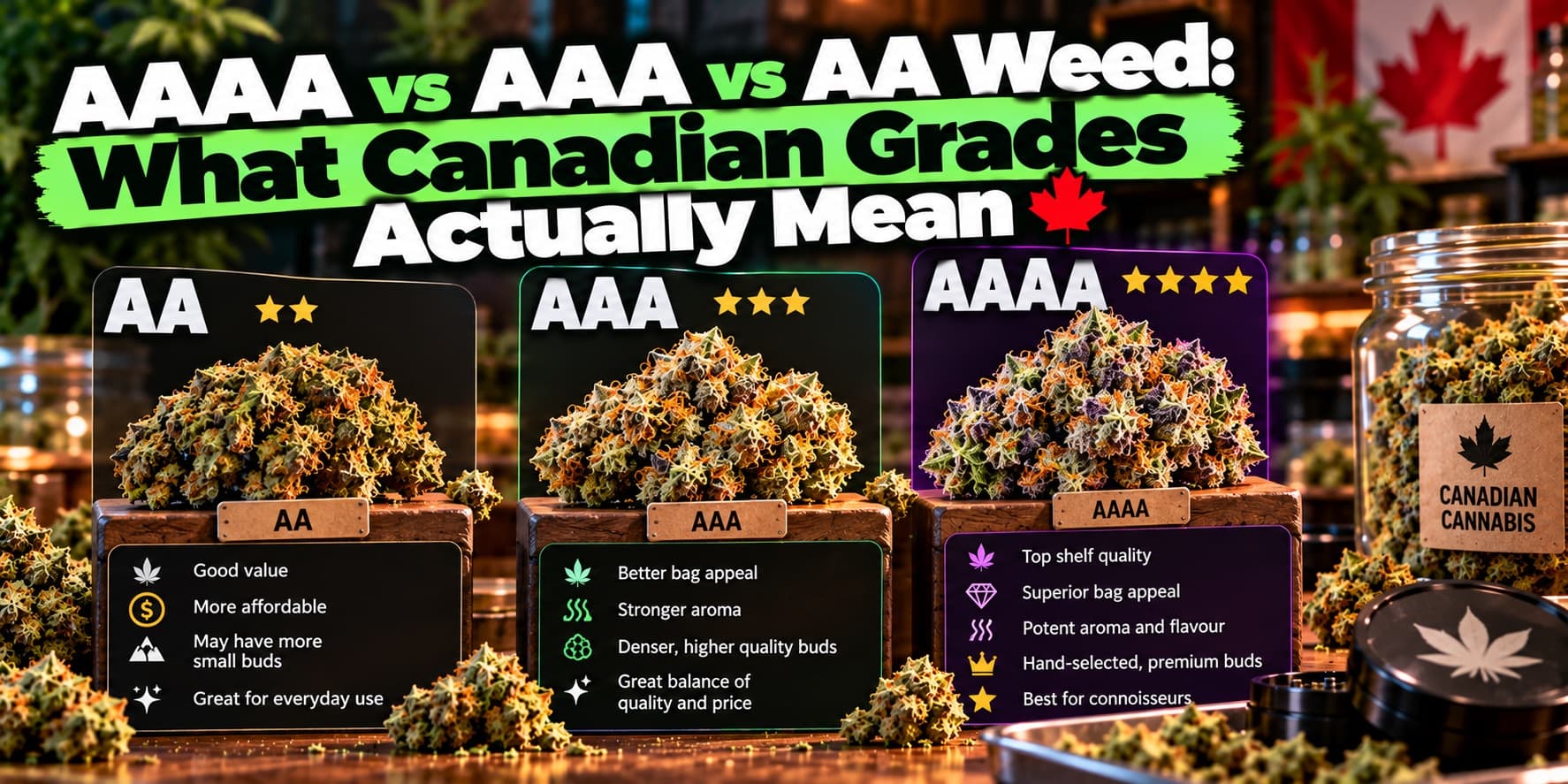
AAAA, AAA and AA are retail quality labels, not regulated grades. There is no legal definition, no certifying body, and no guarantee that one store's AAAA matches another's. The ladder is still useful, but only inside a single store's catalogue. Here is what each tier usually describes, what the research says about whether a higher grade means stronger weed, and how to compare bud across dispensaries when the labels themselves are not comparable.
Key Takeaways
- No one certifies these grades. Health Canada's mandatory label requirements for dried cannabis contain no grade field at all.[1] Each retailer assigns its own.
- The ladder works within a store, not between stores. One shop's AAA can be another's AAAA. Compare grades against a single catalogue, then compare stores on things that do transfer.
- A higher grade does not reliably mean more THC. Total THC varies measurably even between buds on the same plant.[2]
- Frost is not a potency meter. A 2025 review found trichome density is not a dependable proxy for cannabinoid concentration.[3]
- Grades mostly track appearance and handling (bud size, trim quality, cure and structure), which are real quality signals, just not potency signals.
- Buying a larger quantity usually moves your price per gram more than dropping a grade does.
What AAAA, AAA and AA Mean
The Canadian grading shorthand runs from AA at the bottom through AAA and AAAA, with "quads" as the common nickname for AAAA. Some retailers extend it to AAAA+ or five A's, which tells you something about how loose the convention is.
| Grade | Typically describes | Usually suits |
|---|---|---|
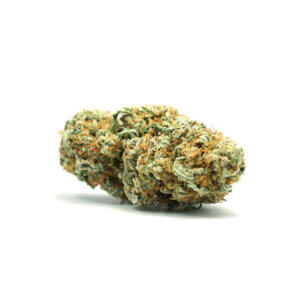
| AAAA (quads) | Dense, well-formed buds, heavy visible trichome coverage, careful hand trim, strong aroma, consistent cure | Buyers who care about presentation and aroma, and are willing to pay the premium for it |
| AAA | Good structure and aroma with more variation bud to bud; machine or mixed trim; the volume tier in most catalogues | The default choice for most regular buyers: the value sweet spot in a lot of stores |
| AA | Looser or smaller buds, more leaf left on, less aromatic, more variability across the bag | Budget buying, or flower destined for edibles, extraction or joints where looks matter less |
Notice what is absent from all three descriptions: a number. The grade describes how bud looks, smells and was handled. It is not a measurement, and nothing about it is audited.
Who Actually Decides the Grade
The retailer does. There is no Canadian body that certifies cannabis grades, no published criteria a shop must meet to call something AAAA, and no penalty for calling it that.
Health Canada's packaging and labelling requirements for dried cannabis specify what must appear on a label: potency figures, the standardised cannabis symbol, warning messages, class of product, packaging date and more.[1] A quality grade is not among them, because it is not a regulated concept. The letters are marketing vocabulary that the industry converged on, not a legal category.
That is not an accusation of dishonesty. Most retailers apply their ladder consistently and it genuinely reflects what they receive from suppliers. It just means the grade is an internal sorting label that happens to be printed where customers can see it.
Why Grades Do Not Transfer Between Stores
Because each store calibrates its own ladder against its own inventory. A dispensary sourcing premium craft flower has to grade within that range. Its AAA may be better bud than a budget-focused competitor's AAAA. Neither is lying; they are measuring against different baselines.
The practical rule: use grades to choose within a store's catalogue, where the ladder is internally consistent. Use lab figures, reviews and price per gram to choose between stores, because those are the only things that mean the same thing everywhere.
Does a Higher Grade Mean More THC?
Not reliably. Potency and appearance are set by different things, and the research is fairly blunt about how much cannabinoid content varies even within a single harvest.
A 2025 study of greenhouse-cultivated dried cannabis measured total THC variability both between plants and between buds on the same plant, finding meaningful spread in both.[2] If two buds from one plant can differ, a visual grade applied to a whole batch is a poor instrument for predicting the number.
Plant structure compounds this. Work on plant architecture and planting density found that how a plant is grown and shaped affects the chemical uniformity of what it yields. Denser planting increased yield per area while reducing cannabinoid uniformity.[4][5] Uniformity is exactly what a single grade label implicitly promises and cannot deliver.
Health Canada's own product testing work comparing legal and illegal dried cannabis also examined how measured potency lines up with what appears on labels, and found the two do not always agree.[6] If the printed number carries uncertainty, a letter grade sitting beside it carries more.
Is Frost a Reliable Potency Signal?
Trichome coverage is the most common visual shortcut for potency, and it is weaker than most people assume. A 2025 peer-reviewed review examining how trichome density is quantified concluded that density measurements are not a dependable stand-in for cannabinoid concentration, and identified real methodological gaps in how the relationship has been studied.[3]
Cultivation research points the same way. A study of increasing light levels in an indoor environment found yield and potency respond differently to the same variable. You can push a plant to produce more, denser flower without moving its cannabinoid concentration proportionally.[7]
What frost does tell you is that the flower was grown and handled reasonably well, and that trichomes were not knocked off by rough trimming or transport. That is a genuine quality signal about care. It is just not a potency reading.
What Genuinely Separates the Tiers
Strip out the potency assumption and the grade ladder still describes something real:
- Bud size and density: larger, denser flower grades higher. Note this is a size and structure sort, which is why popcorn and smalls are a separate axis rather than a rung below AA.
- Trim quality: hand-trimmed flower with little leaf grades above machine-trimmed.
- Cure. Properly cured bud has better aroma, burns more evenly, and is less prone to problems in storage.
- Consistency: the higher the grade, the less variation you should find across the bag.
- Aroma intensity, a proxy for terpene retention through drying, curing and handling.
These are worth paying for. They affect the experience of using the flower. They just do not predict how high you will get.
Checking the Cure Before You Commit
Cure is the one quality factor you can partly assess yourself, and it is the one most likely to have been mishandled.
The industry reference point is water activity. ASTM's specification for dried cannabis flower intended for human use sets an acceptable water activity range of 0.55 to 0.65.[8] Below that range flower turns brittle and sheds trichomes; above it, microbial risk rises sharply.
You will not have a meter in the store, but the proxies are usable. Properly cured bud springs back slightly when squeezed rather than crumbling to dust or feeling damp. Stems snap rather than bend. The aroma is present without any sour, hay-like or ammonia note. Research on post-harvest storage conditions has also shown that how cannabis is kept after harvest measurably changes its chemical profile over time[9], so how long a product has been sitting, and in what, matters alongside how it was graded.
How Grade Affects What You Pay
Each rung up the ladder carries a premium, but the size of it is set by the individual retailer, not by the grade. Because the ladder is not standardised, a AAAA premium at one shop can be a fraction of another's, which is why quoting a universal figure would be misleading.
Two things are worth knowing about cannabis pricing generally. Research tracking the Ontario market five years after legalisation documented how product types, cannabinoid content and prices have shifted over time,[10] and separate work comparing self-reported prices from legal and illegal sources found meaningful differences between the two channels.[11] Prices in this market move, and they move differently by channel and province.
The more reliable lever is quantity. In most catalogues, the per-gram saving from stepping up to a larger weight is larger than the saving from dropping a grade: often substantially. If you are trying to lower your cost per gram, buying more of a grade you like usually beats buying less of a grade you do not.
The same flower, three weights: normalised to price per gram. Note the per-gram cost falls as the weight rises, which is the point: that ladder is steeper than the one the letters describe.
Compare all bulk and mix-and-match deals →
Using Grades to Compare Dispensaries
Here is the problem the letters create, in one row of numbers. Every strain below is sold as premium flower somewhere in Canada, and each could carry a AAAA sticker at one shop and AAA at the next. What does not move between shops is the lab figure:
A 10-point THC spread sits inside that grid, and no grade label would have told you about it. That is the case for reading the panel rather than the sticker.
Since the letters do not transfer between stores, here is what does:
- Reported lab figures. THC and CBD percentages and terpene panels are measurements, not opinions. Treat them as a baseline and check the certificate of analysis for the specific batch.
- Price per gram at the weight you actually buy. Normalise to per-gram before comparing anything, or the headline price will mislead you.
- Reviews describing the bud itself: cure, aroma, moisture, whether the bag matched the photos. These describe exactly the attributes a grade claims to summarise.
- Who you are buying from. Stores that publish full lab panels alongside their grades are easier to hold to their own ladder: MMJ Express, Bulkweedinbox, Bulk Farms, The Grow House and Haute Health all list flower by weight tier so you can do the per-gram comparison yourself.
- Return and replacement policy. The clearest signal a store stands behind its own grading is what happens when a customer says the flower did not match the label.
FAQ
What does AAAA mean on weed?
Is AAAA weed actually stronger than AAA?
Who sets cannabis grades in Canada?
Does AA weed mean bad weed?
Can you compare weed grades between stores?
Does more trichome coverage mean more THC?
Is popcorn weed a grade below AA?
Is it better to buy a higher grade or a bigger weight?
How can you tell if weed was cured properly?
References
- Health Canada. Packaging and labelling guide for cannabis products: Requirements under the Cannabis Act and the Cannabis Regulations. Government of Canada. canada.ca
- Cleary, B., Maloney, K., Toor, A., & Vandermeirsch, G. Variability of total THC in greenhouse cultivated dried Cannabis. Scientific Reports, 2025, 15:25285. DOI: 10.1038/s41598-025-06962-2
- Alberti, T., Didaran, F., Sharma, S., De Sarandy Raposo, R., Diatta, A. A., Maraschin, M., & Da Cunha Leme Filho, J. F. Bracts, Buds, and Biases: Uncovering Gaps in Trichome Density Quantification and Cannabinoid Concentration. 2025.
- Danziger, N., & Bernstein, N. Too Dense or Not Too Dense: Higher Planting Density Reduces Cannabinoid Uniformity but Increases Yield/Area in Drug-Type Medical Cannabis. Frontiers in Plant Science, 2022, 13:713481. DOI: 10.3389/fpls.2022.713481
- Danziger, N., & Bernstein, N. Shape Matters: Plant Architecture Affects Chemical Uniformity in Large-Size Medical Cannabis Plants. Plants, 2021, 10(9):1834. DOI: 10.3390/plants10091834
- Health Canada. Cannabis Data Gathering Program: A comparison of legal and illegal dried cannabis products. Government of Canada, 21 February 2025. canada.ca
- Rodriguez-Morrison, V., Llewellyn, D., & Zheng, Y. Cannabis Yield, Potency, and Leaf Photosynthesis Respond Differently to Increasing Light Levels in an Indoor Environment. Frontiers in Plant Science, 2021, 12:646020. DOI: 10.3389/fpls.2021.646020
- ASTM International. ASTM D8197-22: Standard Specification for Maintaining Acceptable Water Activity (aw) Range (0.55 to 0.65) for Dry Cannabis Flower Intended for Human/Animal Use. ASTM International, 2022. astm.org
- Milay, L., Berman, P., Shapira, A., Guberman, O., & Meiri, D. Metabolic Profiling of Cannabis Secondary Metabolites for Evaluation of Optimal Postharvest Storage Conditions. Frontiers in Plant Science, 2020, 11:583605. DOI: 10.3389/fpls.2020.583605
- Antwi, P., Matheson, J., Balaraju, L., Wickens, C. M., Le Foll, B., Rueda, S., & Di Ciano, P. An update on cannabis products, cannabinoid content, plant type, and prices five years after legalization in Ontario, Canada. Journal of Cannabis Research, 2026.
- Rundle, S., Hong, D. D., Iraniparast, M., Rynard, V., Wadsworth, E., Pacula, R. L., Kilmer, B., & Hammond, D. Self-Reported Cannabis Prices and Expenditures From Legal and Illegal Sources Five Years After Legalisation of Non-Medical Cannabis.
This article is for informational purposes only and is not medical advice. Quality grades such as AAAA, AAA and AA are retail conventions with no legal definition or certifying body in Canada, and are not comparable between retailers. Reported THC and terpene figures vary by batch: check the certificate of analysis for the specific product you buy. Follow the cannabis laws applicable in your jurisdiction. 19+.