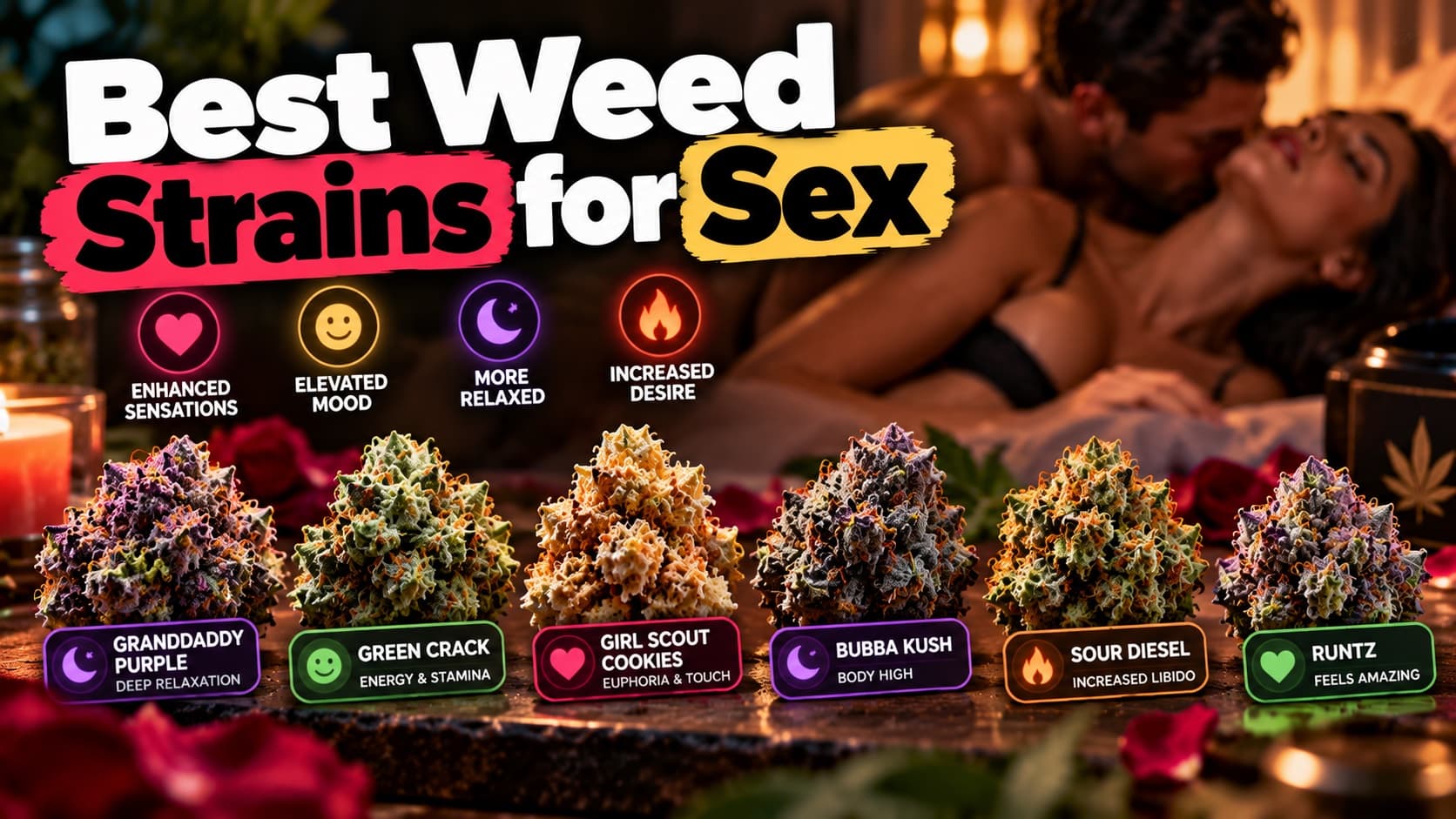
The best cannabis for sex is a moderate-THC strain you have used before, taken shortly beforehand in a small amount. That combination (not the name on the jar) is what the research actually supports. Below are six strains that fit those criteria, with the lab figures for each and an explanation of why it made the list.
Key Takeaways
- Start at the top of the list, not the bottom. The picks are ordered by THC ascending on purpose.
- Timing is the best-supported variable. Every study examining cannabis use immediately before sex reported improved orgasm function.[1]
- Over 70% of surveyed users reported increased desire and orgasm intensity, with women reporting larger increases than men.[2]
- Frequency of use did not predict the effect. Occasional users reported the same benefits as daily ones.[2]
- Too much is the common mistake. High doses are associated with anxiety and difficulty staying present.
- Heavy dependent use points the other way: men with cannabis dependence scored worse on erectile function than controls.[3]
The 6 Picks
Ordered by THC content, lowest first. If you are new to using cannabis this way, start at the top and work down over time rather than jumping to the strongest.
| Strain | Type | THC | Dominant terpenes | Best for |
|---|---|---|---|---|
| Northern Lights | Indica | 18% | Myrcene, caryophyllene, pinene | Lowest THC on the list: the beginner pick |
| Maui Wowie | Sativa | 19% | Myrcene, caryophyllene, limonene | Bright, citrus-forward aroma; less sedating |
| Granddaddy Purple | Indica | 20% | Myrcene, caryophyllene, pinene | Body-heavy and relaxing; better later at night |
| Strawberry Cough | Sativa | 20% | Myrcene, caryophyllene, linalool | Linalool is the floral, calming one. Good if THC makes you anxious |
| Blue Dream | Hybrid | 21% | Myrcene, caryophyllene, pinene | The middle-of-the-road option; widely available |
| Wedding Cake | Hybrid | 25% | Limonene, caryophyllene, myrcene | Strongest here: experienced users only, and use less of it |
THC and terpene figures are the reported values on each strain's Weedpedia page. Individual batches vary considerably: always check the certificate of analysis for the specific product you buy.
Northern Lights. Start here
At 18% THC it is the mildest strain on this list, which is exactly why it leads. Myrcene-dominant and distinctly relaxing, it suits someone who wants the edge taken off without the self-consciousness a stronger product can bring on. It is an evening strain. The sedation is real if you overdo it.
See lab figures and where to buy Northern Lights →
Maui Wowie: the bright one
Limonene in the top three terpenes is what separates this from the rest of the list. Limonene is the citrus note, and products carrying it are commonly described as more uplifting and less couch-locking. At 19% THC it stays moderate. A reasonable choice earlier in the evening.
See lab figures and where to buy Maui Wowie →
Granddaddy Purple: the heavy one
Myrcene-forward and strongly body-focused at 20% THC. Commonly reported as deeply relaxing, which some people want and others find too sedating for this particular purpose. Better suited to a slow night than an energetic one. Lowest CBD on the list at 0.3%.
See lab figures and where to buy Granddaddy Purple →
Strawberry Cough, if THC makes you anxious
The only pick here with linalool in its top three. Linalool is the terpene found in lavender, and it is the one most often associated with calming rather than stimulating. If cannabis has previously made you self-conscious rather than relaxed, this is the profile worth trying at a low dose.
See lab figures and where to buy Strawberry Cough →
Blue Dream: the safe default
A balanced hybrid at 21% THC and the most widely available strain on this list. Nothing about it is extreme, which is the argument for it, if you do not know how you respond yet, an unremarkable middle option is a better test than something at either end.
See lab figures and where to buy Blue Dream →
Wedding Cake: experienced users only
At 25% THC this is meaningfully stronger than everything above it. Limonene-dominant, so the aroma is bright rather than heavy, but the potency is the headline. Included because it is popular and effective for people with the tolerance for it, and flagged because at this strength the dose error we describe below gets easy to make.
See lab figures and where to buy Wedding Cake →
How We Chose Them
Three criteria, applied in order. Most lists on this topic do not say how they were assembled, which makes them impossible to evaluate.
- Moderate THC. The clearest finding in the literature is that high doses produce anxiety, self-consciousness and difficulty staying present.[1] Every pick sits between 18% and 25%, and the list is ordered so the gentlest comes first.
- Terpene profile with a reason. Limonene for brightness, linalool for calm, myrcene for body. These are aroma associations rather than proven pharmacology (see the caveat below), but they are more grounded than picking names at random.
- Actually available in Canada. Every strain here has a live page with dispensaries carrying it. A recommendation you cannot buy is not a recommendation.
Dose: The Variable That Decides It
THC is biphasic: low and high doses produce different, often opposite effects. This is the most common way people get this wrong, and it matters more than which strain you picked.
At lower doses, most people report relaxation, lowered inhibition and heightened sensory focus. At higher doses the same person can experience anxiety, self-consciousness, dissociation from the moment, or sedation: the "difficulty maintaining focus" that the systematic review lists among reported complications.[1]
| Approach | Commonly reported outcome |
|---|---|
| Low dose, familiar product | Relaxation, sensory focus, lowered inhibition |
| Moderate dose | Highly individual: where tracking your own response pays off |
| High dose | Anxiety, self-consciousness, sedation, difficulty staying present |
| Unfamiliar product, any dose | Unpredictable, a poor choice for the occasion |
Use less than you think, and use something you have had before. Quantity and novelty are the two levers most likely to produce the outcome you did not want.
Timing and Form
The most consistent finding across the research is about timing: cannabis used shortly before sexual activity. All nine studies in the systematic review that examined this reported improvements in orgasm function.[1]
| Form | Typical onset | Practical note |
|---|---|---|
| Inhaled (flower, vape) | Minutes | Easiest to titrate. You can feel where you are before continuing |
| Edibles | 30–120 minutes | Long, variable onset. Easy to overshoot by re-dosing too early |
| Tinctures | 15–45 minutes | Middle ground, more predictable than edibles |
| Topicals and lubricants | Localised | Marketed for this; evidence base is thin. Patch test, check condom compatibility |
The 2023 survey found the form used was a significant predictor of reported outcomes, where frequency and duration of use were not.[2]
What the Research Shows
Two bodies of evidence are relevant: survey research on perceived effects, and a systematic review of orgasm-function studies. Both point the same direction, and both carry real limitations.
The survey evidence
A 2023 study in the Journal of Cannabis Research surveyed 811 people aged 18 to 85.[2]
| Finding | Detail |
|---|---|
| Increased desire and orgasm intensity | Reported by over 70% of participants |
| Sex differences | Women reported significantly larger increases in desire than men |
| Multiple orgasms | Over 40% of women reported increased capacity per encounter |
| Erectile function | Men reported no decreased ability to achieve erections |
| Frequency and duration of use | Did not predict outcomes |
| Intentional use before sex | Associated with greater reported benefit than incidental use |
The systematic review
A 2025 review in Sexual Medicine examined 16 studies from 1974 to 2024: one randomised controlled trial and 15 observational studies, covering 15,435 participants.[1] All nine studies looking at use immediately before sex reported improvements in orgasm frequency, ease, intensity, quality or multiorgasmic capacity.
The authors concluded cannabis "appears to be a promising treatment option" for orgasmic difficulty. They also stated that most included studies were observational, lacked comparison groups, carried a high risk of bias, and that none used a formal clinical diagnosis. Both halves belong in an honest summary.
Why the Name Matters Less Than the Numbers
No study has shown that one named strain outperforms another for sex. The 2025 review lists "lack of information on strain specificity" as an explicit evidence gap.[1] So the six picks above are selected on their published chemistry, not on a claim that these particular names were tested.
There is a further wrinkle worth knowing. Peer-reviewed work found samples sold under the same cultivar name are often as genetically and chemically distant from each other as samples with different names,[4] and that commercial indica and sativa labels do not align with chemical composition.[5]
The practical consequence: buy on the batch figures, not the name. Two purchases of the same strain can differ substantially, so check the THC percentage and terpene panel on the product in front of you rather than assuming the name guarantees the profile. The strain pages linked above give you a baseline to compare against.
The Findings That Point the Other Way
Cannabis dependence is associated with worse sexual function in men. A 2025 study compared 30 men with cannabis dependence, 30 with synthetic cannabinoid dependence, and 30 matched controls.[3]
Both dependent groups scored significantly worse on the International Index of Erectile Function than controls (P < .001), and reported lower sexual desire and reduced intercourse satisfaction. That is a small study of clinically dependent users rather than occasional ones, but it is the clearest counterweight in the literature.
The pattern across the evidence: intentional, occasional, low-dose use before sex is where the reported benefits cluster. Heavy dependent use is where the harms appear. The research treats those as different behaviours, and so should you.
Impairment and Consent
Cannabis is an intoxicant, and intoxication affects judgement and the capacity to consent.
Agree on what you are doing before anyone is high, not after. Consent is ongoing and can be withdrawn at any point regardless of what was agreed earlier. If someone is too impaired to make a clear decision, they are too impaired to consent: regardless of prior conversations or relationship history.
Lower doses keep you present, which is both the reported benefit and the safer choice. Those point the same way.
FAQ
What is the best weed strain for sex?
Does weed actually make sex better?
How much should I take?
Is indica or sativa better for sex?
Which terpenes are best for sex?
Do edibles work for this?
Can cannabis cause erectile problems?
Does THC lube work?
References
- Mulvehill, S., & Tishler, J. Cannabis for female orgasmic disorder/difficulty: a systematic review. Sexual Medicine, 2025, 13(4), qfaf061. DOI: 10.1093/sexmed/qfaf061
- Moser, A., Ballard, S. M., Jensen, J., & Averett, P. The influence of cannabis on sexual functioning and satisfaction. Journal of Cannabis Research, 2023, 5(1), 2. DOI: 10.1186/s42238-022-00169-2
- Asal, A. A., Ayoub, D. R., Mazen, M. E., & El Makawi, S. M. Psychosexual dysfunction in male patients with cannabis dependence and synthetic cannabinoid dependence. International Journal of Psychiatry in Medicine, 2025, 60(1), 44–56. DOI: 10.1177/00912174241230886
- Watts, S., McElroy, M., Migicovsky, Z., Maassen, H., van Velzen, R., & Myles, S. Cannabis labelling is associated with genetic variation in terpene synthase genes. Nature Plants, 2021, 7(10), 1330–1334. DOI: 10.1038/s41477-021-01003-y
- Smith, C. J., Vergara, D., Keegan, B., & Jikomes, N. The phytochemical diversity of commercial Cannabis in the United States. PLOS ONE, 2022, 17(5), e0267498. DOI: 10.1371/journal.pone.0267498
This article is for informational and harm-reduction purposes only and is not medical advice. Most research in this area measures self-reported perception rather than physiological outcomes, and the systematic review cited notes a high risk of bias across included studies. THC and terpene figures are reported values and vary by batch: check the certificate of analysis for the product you buy. If you are experiencing sexual dysfunction, speak with a qualified healthcare professional. Cannabis affects individuals differently. Follow the cannabis laws applicable in your jurisdiction. 19+.