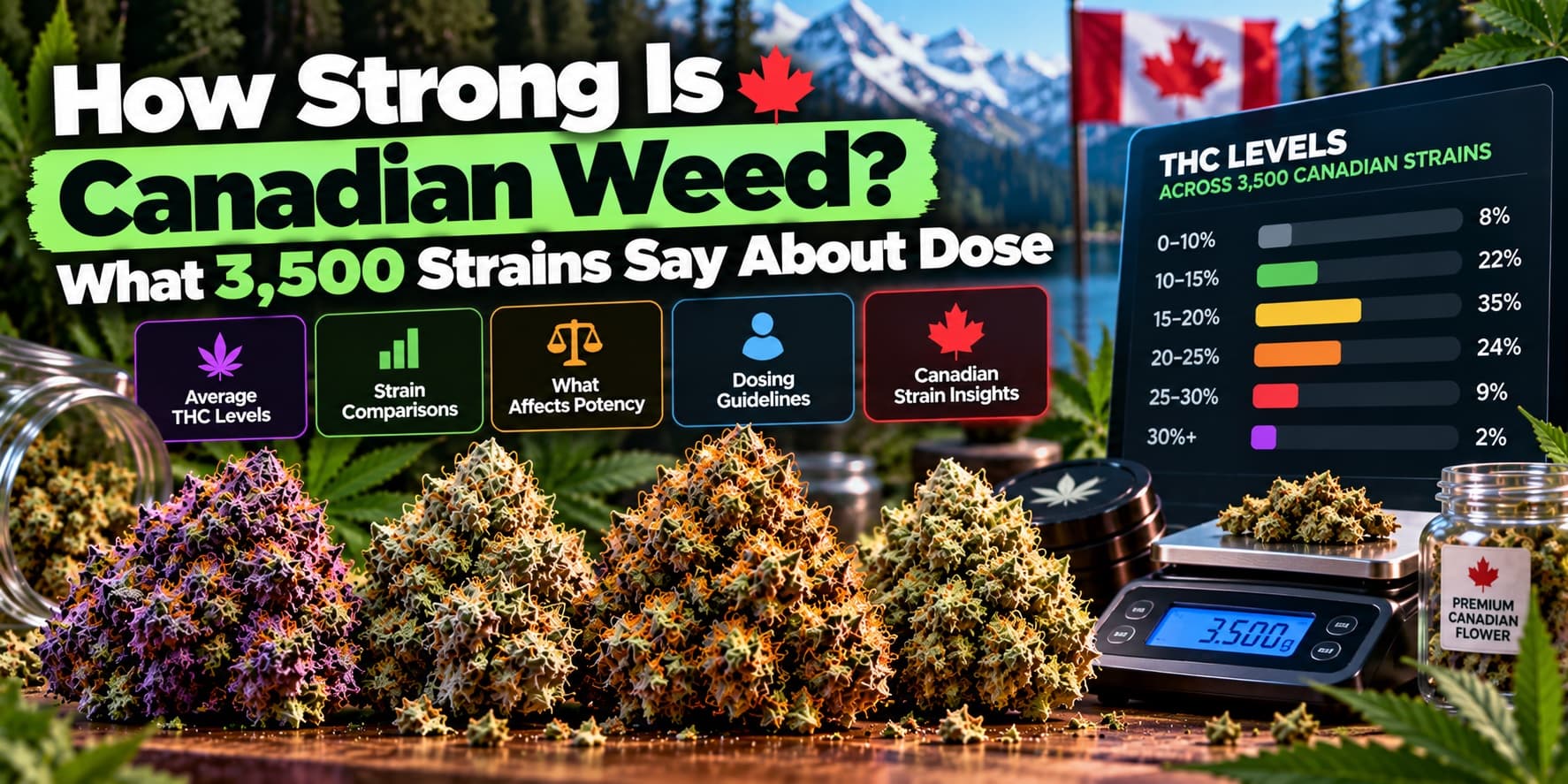
The median cannabis strain listed in Canada tests at 21% THC, and 75.3% of the catalogue sits in a single band between 20% and 25%. The practical consequence is the part worth knowing: the standard harm-reduction advice to "start with something low-THC" points at a shelf that is, for all intents, empty. Across 3,536 published strains, 12 test below 15%.
Key Takeaways
- Median listed THC is 21%, mean 21.3%, across 3,536 published strains.
- 2,662 strains: 75.3%: fall between 20% and 25%. The market is far more uniform than the menu suggests.
- Only 12 strains list below 15% THC, so "start low" is advice the catalogue cannot really honour.
- Just 25 strains (0.7%) list CBD at 1% or higher, which rules out the usual way of softening a high.
- Category barely matters. Indica averages 22.1%, sativa 20.0%: 2.1 points apart.
- Dose is therefore something you control by behaviour, not by product selection.
On this page
What the catalogue actually contains
Listed THC across our published strain database clusters hard. The tenth percentile is 19% and the ninetieth is 24%: eighty percent of everything on offer sits inside a 5-point window. The full range runs from 0.3% to 29%, but the tails are nearly empty.
Read that chart as a shape rather than five numbers. One band holds most of the market, two bands either side hold the remainder, and the extremes are rounding errors. A shopper scrolling a menu experiences enormous apparent variety; the underlying potency distribution is close to a single point.
Why "start low" is hard to follow here
Nearly every piece of first-time guidance, including Health Canada's, reduces to the same instruction: begin with a low-THC product, take a small amount, and wait before taking more. The first half of that is a product recommendation, and it is the half this market cannot fill. 12 strains out of 3,536 list below 15%. 8 list below 10%.
If the lowest-potency option realistically available to you is around 19%, the advice to "start low" stops being about what you buy and becomes entirely about how much of it you use.
The usual secondary route, choosing something with meaningful CBD alongside the THC, is also mostly closed. Only 25 published strains list CBD at 1% or above, which is 0.7% of the catalogue. Whatever one makes of the evidence on CBD moderating the effects of THC, and it is genuinely contested, the option is barely present to choose.
Indica, sativa and the potency myth
Category is the first thing most menus sort by and one of the least informative things about a strain's strength. Indica listings average 22.1% THC across 1,087 strains, hybrids 21.1% across 2,038, and sativas 20.0% across 415.
A 2.1-point gap between category averages is smaller than the spread you will find inside any one category. Choosing indica over sativa does not reliably get you a stronger or a gentler product; it is a claim about reported character, not about dose.
Controlling dose when the floor is high
If the product cannot be your dose control, your behaviour has to be. That is less satisfying than picking a number off a menu, but it is what the distribution leaves you.
The one that catches experienced users out is tolerance. Tolerance to THC falls measurably after even a short break, so a quantity that was routine before a few weeks off is not a safe baseline on return. Effects are commonly reported to build over several minutes when inhaled and considerably longer when eaten; the interval you leave before deciding whether to take more does more to determine where you end up than the strain you chose.
What a listed percentage does not tell you
Two honest caveats, both of which cut against taking these numbers too literally.
First, a listed figure is a headline number for a batch, and the flower in a given jar is not guaranteed to match it. Potency varies between harvests of the same genetics and between parts of the same plant. Treat a listing as a band, not a measurement.
Second, THC percentage describes concentration, not the dose you take or the experience you get. Two people inhaling from the same 22% flower can take in substantially different amounts of THC, and the same amount can land very differently depending on tolerance, setting and what else is in your system. Percentage is one input among several, and it is the one the market has quietly standardised.
The useful reframe: stop reading potency as a dial you can turn down at the point of purchase, and start reading it as a fixed property of this market that you work around afterwards.
FAQ
What is a normal THC percentage for weed in Canada?
Is there any low-THC flower available?
Does indica hit harder than sativa?
Will a high-CBD strain make a high milder?
Is 30% THC flower twice as strong as 15%?
Figures in this article are computed from Weedpedia's published strain database (3,536 strains with a listed THC value) at the time of writing, and will shift as the catalogue changes. Related reading: what Canadian weed grades actually mean, weed measurements explained, and the full strain glossary.
For adults 19+. This article is general information about product data, not medical or dosing advice. Cannabis affects people differently, and tolerance changes over time. If you take prescription medication, are pregnant or breastfeeding, or have a history of psychosis or a heart condition, speak to a healthcare professional before using cannabis.